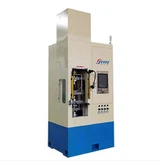
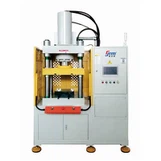
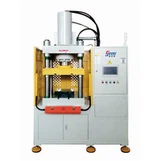
As a supplier of 20 - ton hydraulic presses, I often encounter questions from customers about the diverse applications of our equipment. One of the most frequently asked questions is whether a 20 - ton hydraulic press can be used for powder compaction. In this blog post, I'll delve into this topic, exploring the feasibility, advantages, limitations, and considerations when using a 20 - ton hydraulic press for powder compaction.
Understanding Powder Compaction
Powder compaction is a process where powders are compressed into a solid compact. This technique is widely used in various industries, such as pharmaceuticals, ceramics, and powder metallurgy. The main goal of powder compaction is to transform loose powder particles into a coherent mass with specific physical and mechanical properties, like density, strength, and porosity.
During powder compaction, the powder is placed in a die cavity, and a punch applies pressure to compress the powder. The pressure forces the particles to rearrange, fill voids, and bond together. The quality of the compacted part depends on several factors, including the type of powder, particle size and shape, compaction pressure, and the design of the die and punch.
Can a 20 - Ton Hydraulic Press Be Used for Powder Compaction?
The short answer is yes, a 20 - ton hydraulic press can be used for powder compaction, but it depends on several factors.
Feasibility
For many small - to medium - scale powder compaction applications, a 20 - ton hydraulic press can provide sufficient pressure. For instance, in the production of small ceramic components or some pharmaceutical tablets, the required compaction pressure may be within the capacity of a 20 - ton press.
In powder metallurgy, if the powder has good compressibility and the desired density of the compact is not extremely high, a 20 - ton press can also be suitable. Some soft metal powders, such as aluminum or copper, can be compacted to a reasonable density using a 20 - ton hydraulic press.
Advantages
- Cost - effective: A 20 - ton hydraulic press is generally more affordable than larger - capacity presses. This makes it an attractive option for small businesses or research institutions with limited budgets. For startups in the powder compaction field, a 20 - ton press can serve as an entry - level solution to test the market and develop new products without significant capital investment.
- Space - saving: These presses are usually more compact in size compared to heavy - duty presses. This is beneficial for facilities with limited floor space. A small workshop or laboratory can easily accommodate a 20 - ton hydraulic press, allowing for powder compaction operations without major space - related challenges.
- Ease of operation: They are relatively easier to operate and maintain. Operators can quickly learn how to set up the press for powder compaction tasks, and routine maintenance can be carried out with basic tools and skills. This reduces the need for highly specialized technicians and training.
Limitations
- Limited capacity: The most obvious limitation is the relatively low tonnage. For large - scale powder compaction or when high - density compacts are required, a 20 - ton press may not be sufficient. In powder metallurgy, if you need to produce large - sized components or compact hard metal powders like tungsten or titanium, a higher - tonnage press will be necessary.
- Compaction speed: Compared to some high - speed automated presses, a 20 - ton hydraulic press may have a slower compaction speed. This can be a drawback for mass - production applications where high throughput is crucial.
Considerations When Using a 20 - Ton Hydraulic Press for Powder Compaction
If you decide to use a 20 - ton hydraulic press for powder compaction, there are several important considerations.


Powder Characteristics
- Particle size and shape: Fine powders with irregular shapes may require higher compaction pressures to achieve good bonding and density. If the powder has a wide particle size distribution, it can also affect the compaction process. Coarse particles may create voids in the compact, while fine particles may agglomerate. You need to ensure that the powder you are using is suitable for the pressure capacity of the 20 - ton press.
- Flowability: Good powder flowability is essential for uniform filling of the die cavity. Powders with poor flowability may result in uneven compaction, leading to inconsistent part quality. You may need to use additives or special feeding mechanisms to improve the flowability of the powder.
Die and Punch Design
- Material selection: The die and punch should be made of high - strength materials that can withstand the compaction pressure without deformation. Tool steels are commonly used for powder compaction dies and punches. The hardness and toughness of the material are important factors to consider to ensure a long service life.
- Design optimization: The design of the die and punch should be optimized for the specific powder and compaction requirements. For example, the shape of the die cavity can affect the stress distribution during compaction. A well - designed die can help to achieve uniform compaction and reduce the risk of cracking or delamination in the compacted part.
Process Control
- Pressure control: Precise pressure control is crucial for consistent powder compaction. A 20 - ton hydraulic press should be equipped with a reliable pressure control system to ensure that the desired compaction pressure is applied accurately. This may involve using pressure sensors and feedback control mechanisms.
- Temperature control: In some powder compaction processes, temperature can have a significant impact on the properties of the compact. For example, in the compaction of some polymers or heat - sensitive powders, controlling the temperature of the die and the powder can improve the bonding between particles. You may need to use heating or cooling systems to maintain the appropriate temperature during compaction.
Related Products and Applications
As a supplier of 20 - ton hydraulic presses, we also offer a range of related products. Our Industrial Hydraulic Press Machine series includes presses with different tonnages and configurations, suitable for various industrial applications. If you need a press for more heavy - duty powder compaction or other industrial processes, these machines can be a great choice.
Our Hydraulic Baling Press Machine is another product that can be related to powder compaction in some cases. Although it is mainly used for baling materials, the principles of hydraulic pressure application are similar. Some powder materials can be baled using a hydraulic baling press, which can be an alternative way to handle and store powders.
For customers who require higher - tonnage presses, our Otc 50 Ton Press provides a more powerful solution. It can be used for larger - scale powder compaction or other applications that demand higher pressure.
Conclusion and Call to Action
In conclusion, a 20 - ton hydraulic press can be a viable option for powder compaction in many small - to medium - scale applications. It offers cost - effectiveness, space - saving, and ease of operation advantages, but also has limitations in terms of capacity and speed. By carefully considering the powder characteristics, die and punch design, and process control, you can achieve good results with a 20 - ton press.
If you are interested in our 20 - ton hydraulic presses or any of our other products, we invite you to contact us for further information and to discuss your specific powder compaction requirements. Our team of experts is ready to provide you with professional advice and support to help you make the right choice for your business.
References
- German, R. M. (1994). Powder Metallurgy Science. Metal Powder Industries Federation.
- Schey, J. A. (1983). Introduction to Manufacturing Processes. McGraw - Hill.
- Kalpakjian, S., & Schmid, S. R. (2013). Manufacturing Engineering and Technology. Pearson.