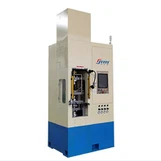
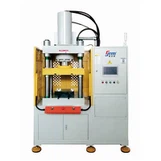
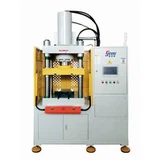
As a supplier of electric servo presses, I often encounter inquiries about the diverse applications of our products. One question that frequently arises is whether an electric servo press can be used for riveting. In this blog post, I'll delve into this topic, exploring the capabilities of electric servo presses in the riveting process, and highlighting the advantages they offer in this context.


Understanding Riveting
Riveting is a mechanical joining process that involves the use of a rivet to connect two or more pieces of material, typically metals. A rivet is a short cylindrical rod with a head on one end. During the riveting process, the rivet is inserted into pre-drilled holes in the materials to be joined. The tail end of the rivet is then deformed, usually by applying pressure, to create a second head, effectively clamping the materials together.
There are several types of riveting, including solid riveting, blind riveting, and semi - tubular riveting, each with its own specific applications and requirements. Solid riveting is commonly used in high - strength applications where a permanent and reliable joint is needed, such as in the aerospace and automotive industries. Blind riveting, on the other hand, is suitable for applications where access to only one side of the joint is possible.
The Working Principle of Electric Servo Presses
Electric servo presses are advanced machines that use a servo motor to drive the ram or slide. The servo motor allows for precise control of the press's motion, including the speed, position, and force. This level of control is achieved through a feedback system that continuously monitors the press's performance and adjusts the motor's operation accordingly.
Compared to traditional mechanical or hydraulic presses, electric servo presses offer several advantages. They are more energy - efficient because the servo motor only consumes power when it is actively working. They also provide higher precision and repeatability, which is crucial for many manufacturing processes. Additionally, electric servo presses can be easily programmed to perform different operations, making them highly versatile.
Using Electric Servo Presses for Riveting
The answer to the question "Can an electric servo press be used for riveting?" is a resounding yes. Electric servo presses are well - suited for riveting applications due to their precise control capabilities.
Precision Control
In riveting, achieving the right amount of force is critical. Too little force may result in an incomplete joint, while too much force can damage the rivet or the materials being joined. Electric servo presses can be programmed to apply a specific force during the riveting process, ensuring consistent and high - quality joints. The ability to control the speed of the ram is also beneficial. A slower speed can be used to gently deform the rivet, reducing the risk of cracking or other defects.
Adaptability
Different riveting applications may require different force profiles and motion patterns. Electric servo presses can be easily programmed to adapt to these variations. For example, in some cases, a multi - stage riveting process may be required, where different forces are applied at different stages of the rivet deformation. Electric servo presses can be programmed to execute such complex operations with ease.
Quality Monitoring
Electric servo presses are equipped with sensors that can monitor various parameters during the riveting process, such as force, position, and displacement. This data can be used to ensure the quality of each riveted joint. If a joint does not meet the specified criteria, the press can be programmed to stop the process and alert the operator, preventing the production of defective parts.
Advantages of Using Electric Servo Presses for Riveting
Higher Quality Joints
As mentioned earlier, the precise control of force and speed provided by electric servo presses results in more consistent and reliable riveted joints. This is especially important in industries where the quality of the joints can have a significant impact on the performance and safety of the final product, such as the automotive and aerospace industries.
Increased Productivity
Electric servo presses can operate at high speeds while maintaining precision. This allows for faster riveting cycles, increasing the overall productivity of the manufacturing process. Additionally, the ability to quickly change between different riveting programs reduces setup times, further improving productivity.
Cost - Effectiveness
Although the initial investment in an electric servo press may be higher than that of a traditional press, the long - term cost savings can be significant. Electric servo presses are more energy - efficient, reducing electricity costs. Their high precision also reduces the number of defective parts, which in turn reduces the cost of rework and scrap.
Comparison with Other Press Types
Hydraulic Servo Press
A Hydraulic Servo Press also offers good force control, but it has some limitations compared to electric servo presses. Hydraulic systems can be more complex and require more maintenance. They also tend to be less energy - efficient due to the constant circulation of hydraulic fluid. Electric servo presses, on the other hand, are simpler in design and have lower maintenance requirements.
Servo Hydraulic Press Machine
The Servo Hydraulic Press Machine combines the features of a servo system with a hydraulic press. While it offers some advantages in terms of force capacity, it still has the drawbacks associated with hydraulic systems, such as fluid leakage and higher energy consumption. Electric servo presses provide a cleaner and more energy - efficient alternative.
High Precision Servo Press
The High Precision Servo Press is a type of electric servo press that is specifically designed for applications that require extremely high levels of precision. When it comes to riveting, a high - precision servo press can ensure the most accurate and consistent results, making it an ideal choice for high - end manufacturing applications.
Considerations When Using Electric Servo Presses for Riveting
When using an electric servo press for riveting, there are a few factors to consider. First, the press's force capacity should be selected based on the size and type of rivets being used, as well as the materials being joined. Second, the tooling used for riveting should be carefully designed and maintained to ensure proper rivet deformation. Finally, the programming of the press should be optimized to achieve the best results, taking into account factors such as the rivet's hardness and the desired joint strength.
Conclusion
In conclusion, electric servo presses are an excellent choice for riveting applications. Their precise control, adaptability, and numerous advantages make them well - suited for a wide range of riveting processes. Whether you are in the automotive, aerospace, or any other industry that requires high - quality riveted joints, an electric servo press can help you achieve your manufacturing goals.
If you are interested in exploring the use of electric servo presses for your riveting needs, I encourage you to contact us for a detailed discussion. Our team of experts can provide you with the information and support you need to make an informed decision. We look forward to the opportunity to work with you and help you enhance your manufacturing processes.
References
- "Manufacturing Processes for Engineering Materials" by Serope Kalpakjian and Steven Schmid.
- "Handbook of Joining Technologies for Materials and Structures" edited by Friedrich Klocke and Frank Micari.