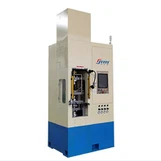
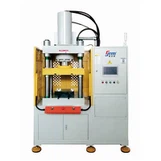
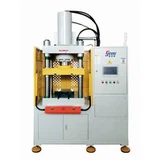
Hey there! As a supplier of Electric Over Hydraulic Presses, I often get asked about how accurate the pressure control of these machines is. It's a crucial question, especially for industries that rely on precise manufacturing processes. So, let's dive right in and explore the accuracy of pressure control in electric over hydraulic presses.


Understanding Electric Over Hydraulic Presses
First off, let's quickly go over what an electric over hydraulic press is. These presses combine the power of hydraulics with the precision of electric control systems. The hydraulic system provides the force needed to perform tasks like stamping, bending, and forming, while the electric component allows for more accurate control of that force.
The basic principle behind an electric over hydraulic press is pretty straightforward. An electric motor drives a hydraulic pump, which then generates pressure in the hydraulic fluid. This fluid is then used to move a piston, which applies force to the workpiece. The key here is that the electric control system can regulate the flow of the hydraulic fluid, thereby controlling the pressure applied by the piston.
Factors Affecting Pressure Control Accuracy
There are several factors that can influence how accurate the pressure control of an electric over hydraulic press is. Let's take a look at some of the most important ones.
1. Quality of the Control System
The control system is the heart of the pressure control in an electric over hydraulic press. A high - quality control system will have advanced sensors and algorithms that can precisely measure and adjust the pressure. For example, some modern control systems use feedback loops to continuously monitor the pressure and make real - time adjustments. If the pressure starts to deviate from the set value, the system can quickly correct it.
On the other hand, a cheap or poorly designed control system may not be able to provide accurate pressure control. It might have inaccurate sensors or slow response times, which can lead to fluctuations in the pressure applied to the workpiece.
2. Hydraulic Fluid Properties
The properties of the hydraulic fluid also play a significant role in pressure control accuracy. Viscosity is one of the most important properties. If the hydraulic fluid is too viscous, it can cause the system to respond slowly to pressure changes. Conversely, if the fluid is too thin, it may not be able to maintain the required pressure.
Temperature can also affect the viscosity of the hydraulic fluid. As the temperature changes, the viscosity of the fluid can change, which in turn can affect the pressure control. That's why many electric over hydraulic presses are equipped with temperature control systems to keep the hydraulic fluid at an optimal temperature.
3. Mechanical Wear and Tear
Over time, the mechanical components of the press, such as the piston, seals, and valves, can wear out. This wear and tear can lead to leaks in the hydraulic system or reduced efficiency in the movement of the piston. As a result, the pressure control accuracy can be compromised.
Regular maintenance is essential to ensure that the mechanical components are in good condition. This includes checking and replacing worn - out parts, as well as lubricating moving parts to reduce friction.
Measuring Pressure Control Accuracy
So, how do we measure the accuracy of pressure control in an electric over hydraulic press? One common way is to use a pressure transducer. A pressure transducer is a device that can convert pressure into an electrical signal. By connecting a pressure transducer to the hydraulic system, we can measure the actual pressure being applied and compare it to the set pressure.
The difference between the set pressure and the actual pressure is known as the pressure error. A smaller pressure error indicates higher accuracy. For example, if the set pressure is 50 tons and the actual pressure measured by the transducer is 50.1 tons, the pressure error is 0.1 tons.
Another way to measure accuracy is to perform a series of tests on the press. We can set the press to different pressure levels and measure the actual pressure applied during each test. By analyzing the data from these tests, we can get a better understanding of the press's pressure control accuracy.
Real - World Applications and Accuracy Requirements
The required accuracy of pressure control varies depending on the application. Let's take a look at some real - world examples.
1. Automotive Industry
In the automotive industry, electric over hydraulic presses are used for tasks like stamping car body parts. High accuracy is crucial in this application because even a small deviation in pressure can lead to parts that don't fit together properly. For example, if the pressure is too high when stamping a door panel, it can cause the panel to be deformed. On the other hand, if the pressure is too low, the panel may not be fully formed.
In the automotive industry, pressure control accuracy of within ±1% is often required. This high level of accuracy ensures that the parts produced are of high quality and meet the strict standards of the automotive industry.
2. Aerospace Industry
The aerospace industry has even more stringent requirements for pressure control accuracy. Electric over hydraulic presses are used to manufacture critical components such as turbine blades and structural parts. These components need to be extremely precise because any defect can have serious consequences for the safety of the aircraft.
In the aerospace industry, pressure control accuracy of within ±0.5% or even better is often required. This level of accuracy ensures that the components are strong, lightweight, and meet the exact specifications of the aerospace design.
Our Company's Approach to Pressure Control Accuracy
As a supplier of Electric Over Hydraulic Presses, we take pressure control accuracy very seriously. We use only high - quality control systems in our presses. Our control systems are equipped with the latest sensors and algorithms to ensure precise pressure control.
We also pay close attention to the selection of hydraulic fluids. We use high - quality hydraulic fluids with stable viscosity properties, and our presses are equipped with temperature control systems to maintain the optimal fluid temperature.
In addition, we provide regular maintenance services to our customers. Our technicians are trained to inspect and maintain the mechanical components of the presses to ensure that they are in good condition and that the pressure control accuracy is maintained over time.
Conclusion
So, how accurate is the pressure control of an electric over hydraulic press? Well, it depends on several factors, including the quality of the control system, the properties of the hydraulic fluid, and the mechanical condition of the press. With the right design, high - quality components, and proper maintenance, electric over hydraulic presses can achieve very high levels of pressure control accuracy.
If you're in the market for an electric over hydraulic press and need high - accuracy pressure control, we've got you covered. We offer a wide range of presses, including the 50 Ton Press, the Jet Hydraulic Press, and Customized Hydraulic Press. Whether you're in the automotive, aerospace, or any other industry, we can provide you with a press that meets your specific requirements.
If you have any questions or are interested in purchasing one of our electric over hydraulic presses, don't hesitate to get in touch. We're here to help you make the right choice for your business.
References
- Hydraulic Press Handbook, Industrial Press Inc.
- Precision Manufacturing Technology Journal, Vol. 15, Issue 3