As a supplier of Servo Mechanical Presses, I understand the importance of accurately measuring the performance parameters of these machines. In this blog post, I will share some key aspects of measuring the performance parameters of a Servo Mechanical Press, which will help you better understand the capabilities and quality of these presses.
1. Force and Pressure Measurement
The force and pressure exerted by a Servo Mechanical Press are fundamental performance parameters. The force output determines the press's ability to deform materials during the stamping or forming process.
- Load Cells: One of the most common methods to measure force is by using load cells. Load cells are transducers that convert force into an electrical signal. They can be installed at various locations on the press, such as between the ram and the die or at the connection points of the press frame. By measuring the electrical output of the load cell, we can accurately determine the force applied during the pressing operation.
- Pressure Sensors: In some cases, especially when dealing with hydraulic - assisted servo presses, pressure sensors are used. These sensors measure the hydraulic pressure within the system. Using the known area of the hydraulic cylinder, we can calculate the force exerted based on the pressure - area relationship (Force = Pressure × Area). For example, if a hydraulic servo press has a hydraulic cylinder with a piston area of 0.1 square meters and the pressure sensor reads 1000 kPa, the force exerted is 100000 N (100 kN). For more information on Hydraulic Servo Press, you can visit our website.
2. Speed and Acceleration Measurement
The speed and acceleration of the press ram are crucial for determining the efficiency and productivity of the stamping process.

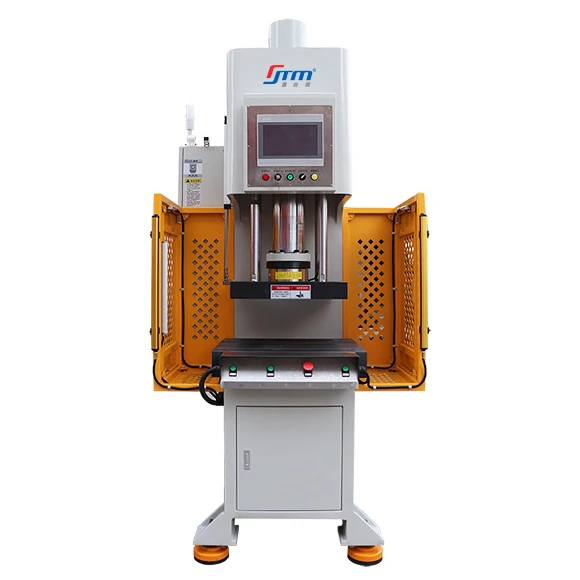
- Encoder Systems: Encoders are commonly used to measure the position, speed, and acceleration of the press ram. An encoder is a device that converts mechanical motion into electrical signals. Incremental encoders generate a series of pulses as the ram moves, and by counting these pulses over a specific time interval, we can calculate the speed of the ram. Absolute encoders, on the other hand, provide a unique digital code representing the exact position of the ram at any given time. By analyzing the change in position over time, we can also determine the acceleration of the ram.
- Laser Doppler Velocimetry (LDV): LDV is a non - contact method for measuring the speed of the ram. It works by shining a laser beam on the moving ram and analyzing the Doppler shift of the scattered light. This method is very accurate and can provide real - time speed measurements. However, it is relatively expensive and requires a clear line of sight to the ram.
3. Position Accuracy Measurement
Position accuracy is essential for ensuring the precision of the stamping or forming process. Even a small deviation in the ram's position can lead to defective parts.
- Linear Variable Differential Transformers (LVDTs): LVDTs are used to measure the linear displacement of the ram. They consist of a primary coil and two secondary coils. When the core of the LVDT moves linearly, the induced voltages in the secondary coils change, and the difference in these voltages is proportional to the displacement of the core. By calibrating the LVDT, we can accurately measure the position of the ram.
- Capacitive Displacement Sensors: Capacitive displacement sensors work based on the change in capacitance between a sensing electrode and a target. As the ram moves, the distance between the sensor and the ram changes, resulting in a change in capacitance. By measuring this change, we can determine the position of the ram. These sensors are highly accurate and can measure very small displacements.
4. Energy Consumption Measurement
Energy consumption is an important performance parameter, especially in today's energy - conscious world. Measuring the energy consumption of a Servo Mechanical Press can help us optimize the operation of the press and reduce costs.
- Power Meters: Power meters are used to measure the electrical power consumed by the press. They can measure parameters such as voltage, current, and power factor. By integrating the power over time, we can calculate the energy consumption of the press during a specific operation cycle.
- Energy Management Systems: Some modern Servo Mechanical Presses are equipped with energy management systems. These systems can monitor the energy consumption in real - time and adjust the operation of the press to optimize energy usage. For example, they can reduce the speed of the press during idle periods or adjust the power output based on the load requirements.
5. Noise and Vibration Measurement
Noise and vibration can affect the working environment and the lifespan of the press. Measuring these parameters can help us identify potential problems and take appropriate measures to reduce them.
- Microphones: Microphones are used to measure the noise level generated by the press. They can be placed at different locations around the press to get a comprehensive understanding of the noise distribution. By analyzing the frequency spectrum of the noise, we can identify the sources of the noise and take measures to reduce it, such as adding sound - absorbing materials or improving the mechanical design of the press.
- Accelerometers: Accelerometers are used to measure the vibration of the press. They can be attached to the press frame, ram, or other components to measure the acceleration in different directions. By analyzing the vibration signals, we can detect abnormal vibrations, which may indicate mechanical problems such as loose parts or misalignment.
6. Torque Measurement
In a Servo Mechanical Press, torque is an important parameter, especially for the servo - motor that drives the press.
- Torque Sensors: Torque sensors are used to measure the torque applied by the servo - motor. They can be installed between the motor shaft and the transmission system. By measuring the torque, we can ensure that the motor is operating within its rated capacity and also detect any abnormal torque variations, which may indicate problems such as overloading or mechanical failures.
Why Choose Our Servo Mechanical Press?
Our Servo Mechanical Press is designed with advanced technology and high - quality components to ensure accurate performance and reliable operation. We have a team of experienced engineers who can provide professional support and solutions for measuring and optimizing the performance parameters of our presses. Whether you need a C Frame Electric Servo Press for small - scale production or a large - capacity servo press for industrial applications, we can meet your needs.
If you are interested in our Servo Mechanical Presses and want to learn more about the performance measurement and other aspects, please feel free to contact us for procurement and negotiation. We are committed to providing you with the best products and services.
References
- ASME (American Society of Mechanical Engineers) standards on press performance measurement.
- ISO (International Organization for Standardization) standards related to machine tool performance evaluation.
- Technical literature from leading servo - press manufacturers.