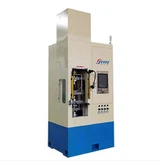
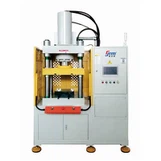
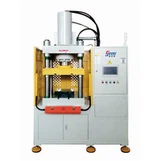
Hey there! As a supplier of High Precision Servo Presses, I've had the privilege of diving deep into the world of these incredible machines. Today, I'm gonna break down the key components that make a high precision servo press tick.
Let's start with the heart of the press - the servo motor. This is what gives the press its precision and control. Unlike traditional motors, servo motors can be precisely controlled in terms of speed, torque, and position. They're designed to respond quickly to commands, allowing for highly accurate movements. Whether you're doing a simple stamping operation or a complex forming process, the servo motor ensures that every movement is spot - on. It can adjust its output based on the specific requirements of the job, which is crucial for maintaining high precision. For example, in a delicate assembly process, the servo motor can apply just the right amount of force to avoid damaging the components.
Next up is the control system. This is the brain of the high precision servo press. The control system is responsible for sending commands to the servo motor and other components of the press. It can be programmed to execute a wide range of operations, from simple single - stroke movements to complex multi - step processes. Modern control systems often come with user - friendly interfaces, allowing operators to easily set up and adjust the press parameters. They also offer features like real - time monitoring and feedback, which help in detecting and correcting any issues during the operation. With the control system, you can fine - tune the press to achieve the exact level of precision you need for your application.
The frame of the press is another important component. A high - quality frame provides the necessary rigidity and stability for the press to operate accurately. It needs to be able to withstand the forces generated during the pressing process without deforming. Frames are usually made of high - strength steel or other durable materials. A well - designed frame also helps in reducing vibrations, which can have a negative impact on the precision of the press. When the frame is rigid and stable, the press can maintain its accuracy over long periods of use, even under heavy loads.


The slide mechanism is what moves up and down to perform the pressing operation. It needs to have smooth and precise movement to ensure accurate results. The slide is typically guided by high - precision linear guides or other types of guiding systems. These guides help in keeping the slide in a straight line and prevent any lateral movement. The slide mechanism also needs to be able to handle the forces exerted during the pressing process without any play or backlash. This is crucial for achieving consistent and accurate results, especially in applications where tight tolerances are required.
Now, let's talk about the die - holding system. This is where the tooling for the pressing operation is mounted. A good die - holding system ensures that the dies are securely held in place and properly aligned. It needs to be able to accommodate different types and sizes of dies. The die - holding system also plays a role in transferring the force from the press to the dies. If the dies are not held correctly, it can lead to uneven pressure distribution and inaccurate results. Some die - holding systems offer features like quick - change capabilities, which allow for faster setup and changeover between different jobs.
In addition to these main components, there are also some auxiliary components that contribute to the overall performance of the high precision servo press. For example, the lubrication system helps in reducing friction and wear between the moving parts. It ensures that the press operates smoothly and efficiently. The cooling system is also important, especially for servo motors and other components that generate heat during operation. A proper cooling system helps in maintaining the optimal temperature of these components, which can extend their lifespan and improve their performance.
When it comes to different types of high precision servo presses, we have Hydraulic Servo Press and Servo Mechanical Press. Hydraulic servo presses use hydraulic power to generate the pressing force. They offer high force capabilities and are suitable for applications that require large amounts of force. Servo mechanical presses, on the other hand, use mechanical linkages and servo motors to generate the force. They are known for their high - speed operation and precise control. Of course, our High Precision Servo Press combines the best of both worlds, offering high precision, speed, and force capabilities.
If you're in the market for a high precision servo press, I encourage you to reach out for a procurement discussion. We can help you choose the right press for your specific needs, whether it's for automotive manufacturing, electronics assembly, or any other industry. Our team of experts is always ready to assist you in understanding the features and benefits of our presses and how they can fit into your production process.
In conclusion, a high precision servo press is a complex machine made up of several key components. Each component plays a vital role in ensuring the press operates with the highest level of precision and efficiency. From the servo motor and control system to the frame, slide mechanism, and die - holding system, every part needs to be carefully designed and engineered. If you're looking for a reliable and high - performing high precision servo press, don't hesitate to contact us for more information.
References
- Various industry publications on servo press technology
- Technical manuals of high precision servo presses