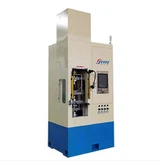
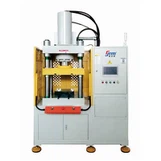
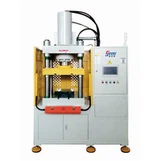
Hey there! As a supplier of precision hydraulic presses, I'm super stoked to break down the working principle of these bad - ass machines for you.
Let's start from the basics. A precision hydraulic press is a powerful piece of equipment widely used in various industries, from automotive to manufacturing. It's all about using the power of fluid to generate a large amount of force.


The Key Components
First up, we've got the hydraulic pump. This is like the heart of the hydraulic press. The pump is responsible for pushing hydraulic fluid, usually oil, through the system. It creates the pressure needed to make the press work. There are different types of hydraulic pumps, like gear pumps, vane pumps, and piston pumps. Each type has its own pros and cons, but they all serve the same basic purpose of moving the fluid.
Next, we have the hydraulic cylinder. This is where the real action happens. The cylinder contains a piston, which is like a big plunger. When the pressurized hydraulic fluid enters the cylinder, it pushes the piston. The movement of the piston is what generates the force that the press uses to perform its tasks. The size of the cylinder and the piston, as well as the pressure of the fluid, determine how much force the press can produce.
We also have the control valves. These valves are used to control the flow and direction of the hydraulic fluid. They can open and close to let the fluid into different parts of the system or to stop its flow altogether. For example, there are directional control valves that decide which way the fluid will go, and pressure control valves that regulate the pressure of the fluid in the system.
The Working Process
Now, let's walk through how a precision hydraulic press actually works step - by - step.
- Fluid Intake: The hydraulic pump starts by sucking in hydraulic fluid from a reservoir. This reservoir is like a big tank that stores the fluid. As the pump rotates, it creates a vacuum that pulls the fluid into the pump.
- Fluid Pressurization: Once the fluid is inside the pump, the pump starts to pressurize it. It squeezes the fluid, increasing its pressure. The pressurized fluid then leaves the pump and enters the hydraulic lines.
- Valve Control: The pressurized fluid travels through the hydraulic lines to the control valves. The operator can use these valves to direct the fluid to the appropriate hydraulic cylinder. For example, if the press has multiple cylinders, the valves can be adjusted to send the fluid to the right one.
- Piston Movement: When the pressurized fluid enters the hydraulic cylinder, it pushes against the piston. The piston moves in a straight line, either up or down depending on the design of the press. This movement of the piston is what creates the force that can be used to press, shape, or form materials.
- Work Execution: The force generated by the moving piston is applied to the workpiece. Whether it's stamping a metal part, molding a plastic component, or compressing a material, the press can perform a wide range of tasks with high precision.
- Fluid Return: After the task is completed, the control valves are adjusted to allow the fluid to flow back to the reservoir. The pressure in the cylinder is released, and the piston returns to its original position, ready for the next cycle.
Applications of Precision Hydraulic Presses
Precision hydraulic presses are used in so many industries, and here are some of the common applications.
In the automotive industry, they're used to stamp metal parts like car body panels, engine components, and transmission parts. The high precision of these presses ensures that the parts are made to exact specifications, which is crucial for the safety and performance of the vehicles.
The aerospace industry also relies heavily on precision hydraulic presses. They're used to manufacture aircraft components, such as wing parts and landing gear components. The ability to apply a large amount of force with high precision is essential for creating parts that can withstand the extreme conditions of flight.
In the manufacturing of plastic products, hydraulic presses are used for injection molding and compression molding. They can create complex shapes with high accuracy, making them ideal for producing everything from small plastic toys to large industrial plastic parts.
Our Product Range
As a supplier, we offer a wide range of precision hydraulic presses to meet different customer needs. For example, we have the 50 Ton Hydraulic Press. This press is suitable for medium - to large - scale manufacturing operations. It can handle a significant amount of force, making it great for tasks like metal forming and stamping.
Our 4 Post Hydraulic Press is known for its stability and precision. The four - post design provides excellent support for the press, ensuring that the force is evenly distributed. This type of press is often used in applications where high accuracy is required, such as in the production of precision parts.
We also have the 30 Tonne Hydraulic Press. It's a more compact option that's perfect for smaller workshops or for applications that don't require as much force. It's still very powerful and can perform a variety of tasks, from light stamping to simple molding.
Why Choose Our Precision Hydraulic Presses
There are a few reasons why you should consider our precision hydraulic presses. Firstly, we use high - quality materials and the latest manufacturing techniques. This ensures that our presses are durable, reliable, and can perform at a high level for a long time.
Secondly, we offer excellent customer service. Our team of experts is always ready to help you choose the right press for your needs, and we can provide technical support and maintenance services.
Finally, our prices are competitive. We understand that cost is an important factor for our customers, and we strive to offer the best value for money.
Contact Us for Procurement
If you're in the market for a precision hydraulic press, we'd love to hear from you. Whether you're a small business looking for a compact press or a large - scale manufacturer in need of a heavy - duty machine, we have the right solution for you. Reach out to us to start the procurement process, and let's work together to find the perfect precision hydraulic press for your operations.
References
- "Hydraulic Systems and Fluid Power" by Fred Shevell
- "Industrial Hydraulics Handbook" by George E. Totten