What Is 4 Post Hydraulic Press?
4 post hydraulic press is a kind of machine with liquid as the working medium, which uses liquid static pressure to transfer energy for realizing various processes. A four column hydraulic press has a hydraulic cylinder that attaches to the top plate or slide.A four post hydraulic presses is composed of four columns. The upper and lower beams form the frame of the hydraulic press, which is usually used to accomplish pressing processes and press molding processes.
Advantages of 4 Post Hydraulic Press
Precision forming, small tolerance and high precision
The pressure generated by the Four Column Hydraulic Press is stable, which reduces die wear and leads to more accurate product formation under numerical control. The forgings produced are of high quality, with minimal burrs and small tolerances, resulting in high precision.
This hydraulic press allows for less cutting processing and eliminates the need for additional turning, milling and planing processes. For example, the tooth shape of cylindrical gears and bevel gears can be directly formed and produced.
The human-machine interface is interactive
The hydraulic press motor is digitally controlled, and the user can input simple displacement and speed parameters to achieve intelligent and flexible numerical control of the process curve. This eliminates the need for the user to compile the process curve, making it extremely convenient to use.
High service life
Numerical pressure control ensures that the mold does not become overloaded, worn or damaged.
High efficiency and energy saving
The four-column hydraulic press has multiple energy-saving features, including no clutch friction power consumption, no flywheel idling power consumption, and high engine efficiency. These features make the servo press efficient and economical.
High equipment reliability
The Four Column Hydraulic Press equipment has no wearing parts, which makes it more durable. The motor's rotor has no windings, conductors, or permanent magnets, making it stronger than a permanent magnet servo motor. It is solid and reliable, as well as impact resistant. Maintenance-free equipment saves maintenance personnel and reduces the time required for maintenance.
Adjust intelligently
The body of the Four Column Hydraulic Press is equipped with a tonnage gauge that allows mold adjustment and testing under pressure control. The mold can be adjusted slowly and without stopping the machine, eliminating the need for special mold adjustment and testing equipment and personnel. This saves mold adjustment work and reduces the time required for the task.
Intelligent automatic numerical control
The operation of the Four Column Hydraulic Press is controlled by high-speed computational intelligence, allowing full automation without the need for manual operation.

Fast hydraulic press uses a liquid pressure of 2-20MPA as the power source, and is externally connected to a three-phase AC380V 50HZ or two-phase AC220 60HZ AC power supply

The main feature of C-Frame Press is its C-shaped body structure, which is similar to a capital English letter "C". The top and bottom are two parallel crossbeams connected by two columns on both sides, forming a closed frame. This structure not only provides strong support, but also reduces vibration and displacement generated during the stamping process, ensuring machining accuracy and stability.

50 Ton Electric Hydraulic Press
A 50 ton electric hydraulic press is a mechanical equipment that uses an electric motor to drive, convert electrical energy into hydraulic energy, and then generate pressure through a hydraulic cylinder to achieve material forming and processing. Its efficient, precise, and safe characteristics make it widely used in industries such as light industry, food, shoemaking, lighting, electrical appliances, toys, hardware equipment, furniture, etc.

Electric Over Hydraulic Press is a molding equipment that combines electric drive and hydraulic transmission technology. It uses an electric motor to drive a hydraulic pump, converting electrical energy into hydraulic energy, and then converting hydraulic energy into mechanical energy through a hydraulic cylinder, achieving process operations such as pressing, forming, stretching, and bending of workpieces.

Efficient design: Jet Hydraulic Press adopts a unique spraying technology that can quickly and effectively inject high-pressure liquid into the working area that needs to be processed, greatly improving work efficiency.
Accurate control: Through a precise control system, it is possible to ensure accurate control of the pressure and flow rate of the liquid during the spraying process, thereby achieving precise processing results.

50 ton pressure is a mechanical equipment that can generate 50 tons of pressure. This type of press is widely used in various production and manufacturing processes that require precise control and the application of a large amount of pressure.

Four Column Three Beam Hydraulic Press
Four column three beam hydraulic press is a hydraulic mechanical equipment that adopts a four column and three plate structure. It uses a hydraulic system to achieve compression, which has the characteristics of simple operation, high pressure, and good stability. It mainly consists of oil cylinders, guide pillars, guide sleeves, movable plates, workbenches, and other parts.
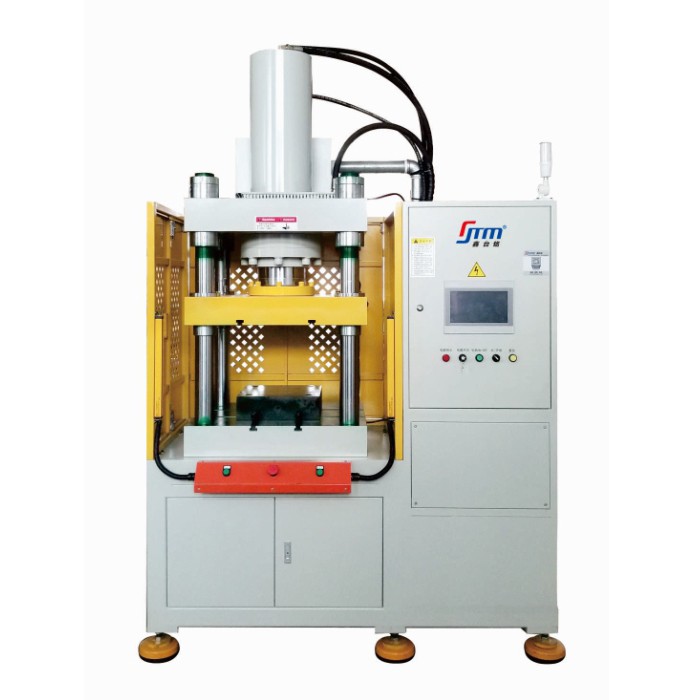
Electric Hydraulic Press for Blacksmithing
Electric Hydraulic Press for Blacksmith is an electric hydraulic press designed specifically for blacksmiths. This device combines electric drive and hydraulic transmission technology to provide efficient and accurate solutions for processes such as forging, pressing, and bending of metal materials.

75 ton hydraulic press is a high-performance mechanical equipment mainly used for pressing and forming processes of materials such as metal, plastic, rubber, etc.
Our factory
Shenzhen xintaiming intelligent equipment co., ltd. Was established in 2008 and is a manufacturer of precision press equipment and intelligent systems with nearly 20 years of experience in the hydraulic equipment industry.
Advanced equipment
Having multiple production equipment, such as high-precision cnc machine tools, large water mills, precision carving machines, cutting machines, milling machines, etc.
High quality
Our products are manufactured to very high standards, using the finest materials and manufacturing processes.
Customized services
According to customer needs and scenarios, to provide personalized customized program to meet the special needs of customers.
24h online service
We try and respond to all concerns within 24 hours and our teams are always at your disposal in case of any emergencies.
Types of 4 Post Hydraulic Press
Single action press
These presses have a single ram that applies force in one direction, suitable for simple pressing tasks.
Double action press
With two rams that move in opposite directions, these presses offer increased versatility and efficiency for complex pressing operations.
Triple action press
Featuring three rams for precise control over the pressing process, ideal for high-precision manufacturing applications.
Application of 4 Post Hydraulic Press
Automotive
Used to stamp metal parts for cars and trucks.
Aerospace
Used to manufacture aircraft components.
Construction
Used to shape metal beams and columns.
Electronic products
Used to assemble electronic components.
Plastic Molding
Used to make plastic products.
Metalworking
For forging, stamping, and bending sheet metal.
Food processing
Used to press and package food.
Recycling
Used to compact recyclable materials.
Components of 4 Post Hydraulic Press
Frame: A strong frame provides structural support to the machine and houses the major components.
Four uprights: These uprights guide the movement of the platen and ensure precise alignment.
Pressure plate: A movable part of a machine that applies pressure to the workpiece.
Hydraulic cylinder: A hydraulic cylinder generates the force required to move the platen. It consists of a piston and a cylinder filled with hydraulic oil.
Pump and control system: The pump supplies pressurized hydraulic oil to the cylinder, and the control system adjusts the flow and pressure of the oil to control the movement of the pressure plate.
How to Maintain 4 Post Hydraulic Press


Keep a clean working area
Maintaining a clean press environment is vital. Regularly remove debris, dust, and excess material from the press area. Pay particular attention to the moving parts, as dirt buildup can cause friction and wear down components over time. This is also an important step for safe operation, as dust and oil can cause tripping hazards.
Proper lubrication
Proper lubrication is essential to prevent friction-related issues. Follow the manufacturer's guidelines to ensure you're using the right type of lubricant and applying it to the correct parts. Remember that over-lubrication can be just as damaging as under-lubrication, so it's important to strike the right balance.
Inspect and replace wear parts
Factory presses perform intense jobs with lots of force, and some wear and tear is inevitable. Catching signs of wear and tear early can prevent larger issues. Regularly inspect components such as valves, bearings, and seals. Replace any worn or damaged parts promptly to prevent further damage and maintain press efficiency.
Tighten loose fasteners
Vibrations from press operations can cause nuts and bolts to loosen over time. Regularly check and tighten all fasteners to prevent parts from shifting and causing misalignment or damage. Loose or missing fasteners endangers the stability of the machine, but small parts getting caught in the machine can also cause serious damage and risks.
Monitor press performance
Pay attention to the press's performance and be aware of unusual sounds, vibrations, or variations in product quality. Some press features, like force and distance monitoring capabilities, will show when the press is working outside normal parameters. Ignoring these issues can cause full machine break-down later down the line.
Inspect hydraulic fluid
Regularly check the hydraulic fluid levels and quality. Contaminated or low fluid levels can lead to poor press performance or even catastrophic failures. Follow the manufacturer's recommendations for fluid type and change intervals. Check that the oil temperature is also correct, according to the manufacturer's recommendations.
Check hydraulic hoses and seals
A small hydraulic fluid leak can quickly become a big problem and present a safety hazard. Regularly inspect hydraulic hoses for signs of wear, bulges, or leaks. Also, examine seals for signs of damage. Replace any compromised hoses or seals quickly to prevent fluid leakage and maintain press safety.
Maintain cooling systems
Hydraulic systems can generate heat during operation. Ensure that cooling systems, such as fans, heat exchangers, or water-cooled systems are functioning correctly to prevent overheating and fluid degradation. Check filters for dirt and dust, and check water pipes for rust or salt build-up, where applicable.
Check electrical lines
Damaged or frayed electrical lines can be a hazard for any equipment, but this is especially important for hydraulic presses, since hydraulic fluid is flammable. Regularly check electrical cords and sockets for damage, and make repairs or replacements promptly.
How the 4 Post Hydraulic Press Works
The core power source of a hydraulic press is the hydraulic system, which operates based on the pascal principle. The hydraulic system consists of an oil tank, hydraulic pump, various control valves, hydraulic pipelines, and hydraulic cylinders. When the electric motor drives the hydraulic pump to rotate, the hydraulic oil is sucked in and pressurized, and then transmitted to the hydraulic cylinder through a control valve. The internal piston of the hydraulic cylinder generates a huge thrust under the action of high-pressure oil, pushing the upper crossbeam downward, thereby applying pressure to the workpiece placed on the workbench.
Pre compression stage
The operator sets the required pressure or stroke through the control panel, the hydraulic pump starts, the oil enters the master cylinder, and the piston begins to slowly descend, making initial contact and positioning of the workpiece.
Forming stage
With further pressurization of the hydraulic system, the upper crossbeam rapidly and stably descends, applying a predetermined forming pressure to the workpiece. The material undergoes plastic deformation under strong and uniform force, completing process requirements such as stamping, bending, and deep drawing.
Pressure holding and unloading stages
After reaching the required forming depth or pressure, the hydraulic system enters a pressure holding state, which is maintained for a period of time to ensure the stability and quality of the workpiece shape. Subsequently, by releasing the control valve, the high-pressure oil in the hydraulic cylinder flows back to the oil tank, causing the piston to rise and complete a working cycle.
Safety Precautions When Using the 4 Post Hydraulic Press
1. The operator of the hydraulic press must be trained and guided, and master the performance and operation technology of the hydraulic press before using the hydraulic press.
2. Before using the hydraulic press, it is necessary to clean all kinds of sundries on the hydraulic press and check whether the power supply of the hydraulic press is normal.
3. The installation of the hydraulic press mold must be carried out under the condition of power failure. It is forbidden to operate the hydraulic press mold by multiple people, and it is forbidden to touch the power switch, start button, foot switch, etc.
4. Ensure that the upper and lower molds are installed and fixed correctly without error, and the molds can be opened and closed normally.
5. Before the hydraulic press works, first start the equipment to idle for 3-5 minutes. During this period, check whether the oil level gauge of the oil tank meets the standard, whether the sound of the hydraulic press is normal, whether the hydraulic integrated valve block, hydraulic pipe, joint and hydraulic cylinder have oil leakage, and whether the functions of the limit device and safety protection device are normal. Manually adjust the required pressure, time and position.
6. Test the product workpiece, check whether the pressure is sufficient, whether the action of the hydraulic press is safe and reliable, and adjust the working pressure of the hydraulic press. The maximum pressure cannot exceed the rated pressure of the nominal force of the hydraulic press by more than 90%. After the tested products are qualified, they can be used in normal production. For different production processes, the pressure, time and position of the hydraulic press should be adjusted before normal use, so as to ensure that the machine and mold will not be damaged. It is forbidden for multiple people to operate the same hydraulic press at the same time, and it is forbidden to stretch their hands and other parts into the workbench. At the same time, ensure that the periphery of the hydraulic press is clean and free of other debris.
7. After the hydraulic press is completed, all power supplies should be cut off and the hydraulic press should be cleaned. Place common tools neatly and put them back in place.
Our Factory
The company's headquarters is located in Longgang District, Shenzhen, with a factory area of over 10000 square meters. In 2014, Jiangxi Xintaiming Intelligent Technology Co., Ltd. was established as a production base with a self built factory of over 40000 square meters in Fuzhou High tech Zone, Jiangxi.
Our Certificate
We have 5 invention patents, 53 utility model patents, 3 appearance patents, and 20 software copyrights, and have been awarded the National High tech Enterprise Certificate, ISO9001 Quality Management System Certification, and ISO14001 Environmental Management System Certification. We have independent export qualifications.


FAQ
Hot Tags: 4 post hydraulic press, China 4 post hydraulic press manufacturers, suppliers, factory, hydraulic press commissioning, hydraulic press delivery, hydraulic press fairs, 50 Ton Press, 20 Ton Benchtop Press, 30 Ton Press