Energy saving
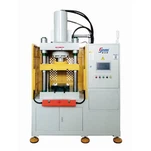
Compared with ordinary hydraulic presses, the servo hydraulic press [1] does not contain proportional servo valves or proportional pumps in the overall control of the system. The servo hydraulic press has the advantages of energy saving, low noise, low temperature rise, good flexibility, high efficiency, and easy maintenance. It can replace most existing ordinary hydraulic presses and has broad market prospects. Compared with traditional hydraulic presses, the energy saving effect is significant. Depending on the processing technology and production cycle, the servo hydraulic press can save 30% to 70% of electricity compared with traditional hydraulic presses.
Low noise
The oil pump of the servo hydraulic press generally uses an internal gear pump or a high-performance vane pump. Traditional hydraulic presses generally use axial piston pumps. Under the same flow and pressure, the noise of the internal gear pump or vane pump is 5dB to 10dB lower than that of the axial piston pump. When the servo hydraulic press is pressing and returning, the motor runs at the rated speed, and its emission noise is 5dB to 10dB lower than that of the traditional hydraulic press. When the slider is falling quickly and the slider is stationary, the servo motor speed is 0, so the servo hydraulic press has basically no noise emission. During the pressure holding stage, due to the low motor speed, the noise of the servo-driven hydraulic press is generally less than 70dB, while the noise of the traditional hydraulic press is 83dB~90dB. After testing and calculation, under normal working conditions, the noise generated by 10 servo hydraulic presses is lower than that generated by an ordinary hydraulic press of the same specifications.
Less heat
Since the hydraulic system of the servo-driven hydraulic press has no overflow heat and no flow when the slider is stationary, there is no hydraulic resistance heat, and the heat generated by its hydraulic system is generally 10%~30% of that of the traditional hydraulic press. Due to the low heat generated by the system, most servo-driven hydraulic presses do not need a hydraulic oil cooling system, and some servo-driven hydraulic presses with larger heat generation can be equipped with a low-power cooling system. Due to the characteristics of the pump being at zero speed and low heat generation most of the time, the oil tank of the servo-controlled hydraulic press can be smaller than that of the traditional hydraulic press, and the oil change time can also be extended, so the hydraulic oil consumed by the servo-driven hydraulic press is generally only about 50% of that of the traditional hydraulic press.
High degree of automation
The pressure, speed, and position of the servo-driven hydraulic press are fully closed-loop digital control, with a high degree of automation and good precision. In addition, its pressure and speed can be programmably controlled to meet various process requirements, and remote automatic control can also be achieved.
High efficiency
Through appropriate acceleration and deceleration control and energy optimization, the speed of the servo-controlled hydraulic press can be greatly improved, and the working cycle is several times higher than that of the traditional hydraulic press, which can reach 10/min~15/min.
Convenient maintenance
Due to the elimination of the proportional servo hydraulic valve, speed control circuit, and pressure regulation circuit in the hydraulic system, the hydraulic system is greatly simplified. The cleanliness requirements for hydraulic oil are much lower than those of the hydraulic proportional servo system, which reduces the impact of hydraulic oil pollution on the system.
Development direction
Although the traditional hydraulic press system adopts the energy-saving solution of constant power variable pump, when the machine tool is in the state of fast down, pressure maintenance, and robot loading and unloading, the three-phase asynchronous motor will still drive the oil pump to work, and the output oil will overflow back to the oil tank through the hydraulic system at this time, which will greatly waste energy. At the same time, the circulating overflow is also very likely to cause the oil temperature to rise. The pump-controlled electro-hydraulic servo technology uses the high-speed response of the servo motor to achieve instant oil supply. It can also achieve different pressures and flows required in various process steps. By real-time detection of the pressure and flow signals from the hydraulic press control system, the servo motor speed required for each working condition is adjusted in time, so that the flow and pressure output by the pump can meet the needs of the system to the maximum extent. In the non-action state, the servo motor is kept running at a low speed. In general, the energy saving effect can reach 20%-70% compared with that before the transformation. In addition, the noise and oil temperature are also significantly reduced. At the same time, because the servo drive is used, the intelligent transformation and upgrading of the hydraulic press can be easily carried out. It is certain that the servoization of hydraulic presses is the future development direction, and the servo energy-saving transformation of hydraulic presses can also obtain huge efficiency. It is believed that this cost-effective pump-controlled electro-hydraulic servo system will be recognized by more customers and will surely promote the transformation of the entire industry.