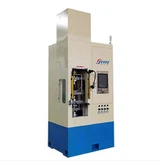
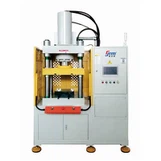
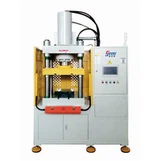
As a supplier of Jet Hydraulic Presses, I often encounter inquiries from customers about the diverse applications of our products. One question that frequently arises is whether a Jet Hydraulic Press can be used for riveting operations. In this blog post, I will delve into the technical aspects, potential advantages, and practical considerations to provide a comprehensive answer.
Technical Feasibility of Jet Hydraulic Presses in Riveting
A Jet Hydraulic Press operates on the principle of Pascal's law, which states that when pressure is applied to a confined fluid, the pressure change occurs throughout the entire fluid. In the press, a hydraulic pump generates high - pressure fluid, which is then used to drive a piston, creating a large amount of force at the press head.
Riveting is a process of joining two or more pieces of material, typically metals, by deforming a rivet. The force required for riveting depends on factors such as the type of rivet, the materials being joined, and the size of the rivet. Jet Hydraulic Presses are capable of delivering consistent and controlled force, which is a crucial requirement for successful riveting.
When it comes to riveting, the press needs to be able to apply the right amount of force to deform the rivet without causing damage to the surrounding materials. Jet Hydraulic Presses can be precisely calibrated to provide the necessary force. The hydraulic system allows for fine - tuning of the pressure, ensuring that the riveting process is carried out accurately. For example, in applications where thin sheets of metal are being riveted together, a lower pressure setting can be used, while thicker materials may require a higher pressure.
Advantages of Using Jet Hydraulic Presses for Riveting
-
High Force and Precision
Jet Hydraulic Presses can generate a significant amount of force, which is essential for riveting large or thick - walled rivets. The hydraulic system provides a smooth and consistent force application, resulting in uniform rivet deformation. This precision is crucial for ensuring the quality and strength of the riveted joint. In contrast, mechanical presses may experience variations in force due to factors such as wear and tear of mechanical components, which can lead to inconsistent riveting results. -
Versatility
Our Jet Hydraulic Presses are highly versatile and can be adapted to different riveting applications. They can handle a variety of rivet types, including solid rivets, blind rivets, and tubular rivets. Additionally, the press can be used for riveting different materials, such as steel, aluminum, and copper. This versatility makes the Jet Hydraulic Press a valuable asset for manufacturers who need to perform multiple types of riveting operations. -
Safety
Safety is a top priority in any manufacturing process. Jet Hydraulic Presses are equipped with safety features such as overload protection, emergency stop buttons, and safety guards. These features help to prevent accidents and ensure the well - being of operators. In the riveting process, the controlled force application of the hydraulic press reduces the risk of sudden force surges, which can be dangerous. -
Customization
We offer Customized Hydraulic Press solutions to meet the specific requirements of our customers. For riveting operations, we can customize the press in terms of force capacity, stroke length, and worktable size. This means that customers can get a press that is tailored to their exact riveting needs, whether it is for small - scale production or large - scale industrial applications.
Practical Considerations for Riveting with Jet Hydraulic Presses
-
Tooling
Appropriate tooling is essential for successful riveting with a Jet Hydraulic Press. The tooling includes dies and punches that are designed to fit the specific type of rivet being used. The dies need to be precisely machined to ensure proper alignment and deformation of the rivet. We can provide guidance on selecting the right tooling for different riveting applications. -
Maintenance
Regular maintenance of the Jet Hydraulic Press is crucial for its long - term performance in riveting operations. This includes checking the hydraulic fluid level, inspecting the seals for leaks, and lubricating moving parts. Proper maintenance ensures that the press operates smoothly and reduces the risk of breakdowns, which can disrupt production. -
Operator Training
Operators need to be properly trained to use the Jet Hydraulic Press for riveting. They should understand the operating principles of the press, how to set the correct pressure and stroke, and how to handle the tooling. Our company offers training programs to ensure that operators can use the press safely and efficiently.
Comparison with Other Riveting Methods
-
Manual Riveting
Manual riveting is a labor - intensive process that requires a high level of skill from the operator. It is suitable for small - scale or low - volume production. In contrast, using a Jet Hydraulic Press for riveting is much faster and more consistent. The press can perform riveting operations at a higher rate, increasing productivity and reducing labor costs. -
Pneumatic Riveting Tools
Pneumatic riveting tools are commonly used in some industries. While they are relatively lightweight and portable, they may not be able to generate as much force as a Jet Hydraulic Press. This limits their use for riveting large or thick - walled rivets. Additionally, pneumatic tools may experience variations in performance due to changes in air pressure, while hydraulic presses provide a more stable force output.
Real - World Applications
Jet Hydraulic Presses are widely used in various industries for riveting operations. In the automotive industry, they are used to rivet components such as body panels, engine mounts, and suspension parts. The high force and precision of the press ensure the structural integrity of these components.
In the aerospace industry, where safety and precision are of utmost importance, Jet Hydraulic Presses are used for riveting critical parts of aircraft. The ability to control the riveting process precisely helps to meet the strict quality standards of the industry.
The manufacturing of electronic devices also benefits from the use of Jet Hydraulic Presses for riveting. The press can be used to assemble small components with high precision, ensuring the proper functioning of the devices.
Conclusion
In conclusion, a Jet Hydraulic Press can indeed be used for riveting operations. Its technical capabilities, such as high force, precision, and controllability, make it a suitable choice for a wide range of riveting applications. The advantages of using a Jet Hydraulic Press, including versatility, safety, and customization options, further enhance its appeal for manufacturers.
If you are considering using a Jet Hydraulic Press for your riveting operations, we are here to help. We have a wide range of products, including Hydraulic Baling Press Machine and 50 Ton Press Cylinder, to meet your specific requirements. Contact us to discuss your needs and explore how our Jet Hydraulic Presses can improve your riveting process.


References
- Smith, J. (2019). Hydraulic Press Technology: Principles and Applications. Engineering Press.
- Brown, A. (2020). Riveting Techniques in Modern Manufacturing. Manufacturing Journal.
- Johnson, M. (2021). Safety Standards for Hydraulic Presses. Industrial Safety Review.