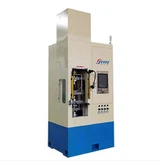
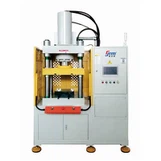
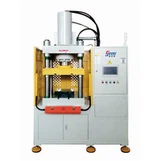
When it comes to industrial machinery, the 20 ton hydraulic press stands as a remarkable piece of equipment that combines power and precision. As a supplier of 20 ton hydraulic presses, I often encounter inquiries about the physical dimensions and capabilities of these machines. In this blog post, I'll delve into the details of how big a 20 ton hydraulic press is and explore its various aspects.
Physical Dimensions
The size of a 20 ton hydraulic press can vary depending on its design, intended application, and the manufacturer. Generally, a standard 20 ton hydraulic press has a compact footprint that makes it suitable for a wide range of industrial settings, including small workshops and large manufacturing plants.
The overall height of a 20 ton hydraulic press typically ranges from 4 to 6 feet. This height includes the frame, the hydraulic cylinder, and the worktable. The height is designed to provide easy access for operators to load and unload workpieces while maintaining a stable and secure structure.
The width of the press usually falls between 3 to 5 feet. This width allows for sufficient space to accommodate different types of tools and dies, as well as to ensure smooth operation of the hydraulic system. The width also plays a crucial role in determining the maximum size of the workpieces that can be processed by the press.
The depth of the press, which refers to the distance from the front to the back of the machine, is typically around 2 to 4 feet. This depth provides enough room for the hydraulic cylinder to extend and retract, as well as for the installation of additional components such as control panels and safety guards.
It's important to note that these dimensions are approximate and can vary depending on the specific model and configuration of the 20 ton hydraulic press. Some presses may be designed with a more compact footprint to save space, while others may have a larger size to accommodate specialized applications or larger workpieces.
Worktable Size
The worktable is an essential part of the 20 ton hydraulic press, as it provides a stable surface for placing the workpieces during the pressing process. The size of the worktable can vary depending on the intended application of the press.
In general, the worktable of a 20 ton hydraulic press has a length of around 2 to 4 feet and a width of 1 to 3 feet. This size allows for the processing of a wide range of workpieces, from small precision parts to larger components. The worktable may also be equipped with T-slots or other fixtures to secure the workpieces and prevent them from moving during the pressing operation.
Some 20 ton hydraulic presses may have a larger worktable to accommodate larger workpieces or to allow for the use of multiple dies simultaneously. These presses are often used in industries such as automotive manufacturing, aerospace, and metalworking, where large-scale production is required.
Hydraulic Cylinder Size
The hydraulic cylinder is the heart of the 20 ton hydraulic press, as it is responsible for generating the force required to perform the pressing operation. The size of the hydraulic cylinder can vary depending on the design and specifications of the press.
Typically, a 20 ton hydraulic press is equipped with a hydraulic cylinder with a bore diameter of around 3 to 5 inches and a stroke length of 6 to 12 inches. The bore diameter determines the amount of force that the cylinder can generate, while the stroke length determines the maximum distance that the cylinder can extend and retract.
The size of the hydraulic cylinder also affects the overall size and weight of the press. A larger cylinder will generally require a more robust frame and a larger hydraulic system to support its operation. Therefore, the size of the cylinder is carefully selected to balance the required force with the overall size and cost of the press.
Applications and Capabilities
The 20 ton hydraulic press is a versatile machine that can be used in a wide range of applications, including metal forming, stamping, punching, bending, and assembly. Its relatively compact size and high force capacity make it suitable for both small-scale and large-scale production.
In the metalworking industry, the 20 ton hydraulic press is commonly used for tasks such as blanking, piercing, and embossing. It can also be used for the production of small precision parts, such as gears, bearings, and fasteners. The press can be equipped with different types of dies to perform various operations, allowing for a high degree of flexibility and customization.


In the automotive industry, the 20 ton hydraulic press is used for the production of components such as engine blocks, transmission cases, and body panels. It can also be used for the assembly of automotive parts, such as the installation of bearings and seals. The press's high force capacity and precision make it an ideal choice for these applications, where quality and reliability are crucial.
In the aerospace industry, the 20 ton hydraulic press is used for the production of lightweight components, such as aircraft wings and fuselage sections. It can also be used for the assembly of aerospace parts, such as the installation of rivets and bolts. The press's ability to apply precise force and control the deformation of materials makes it suitable for these applications, where strict quality standards must be met.
Comparison with Other Presses
When considering the size and capabilities of a 20 ton hydraulic press, it's useful to compare it with other types of presses. For example, a 20 Ton Electric Hydraulic Press offers the advantage of being more energy-efficient and easier to operate compared to a traditional hydraulic press. It also has a similar size and force capacity, making it a suitable alternative for many applications.
On the other hand, a Hydraulic Baling Press Machine is designed specifically for the baling of materials, such as scrap metal, paper, and plastic. It has a larger size and a higher force capacity compared to a 20 ton hydraulic press, and is typically used in recycling facilities and waste management operations.
A 30 Ton Press has a higher force capacity than a 20 ton hydraulic press, making it suitable for more heavy-duty applications. However, it also has a larger size and a higher cost, which may not be suitable for all users.
Conclusion
In conclusion, the size of a 20 ton hydraulic press can vary depending on its design, intended application, and the manufacturer. Generally, it has a compact footprint with an overall height of 4 to 6 feet, a width of 3 to 5 feet, and a depth of 2 to 4 feet. The worktable size, hydraulic cylinder size, and other components also contribute to the overall size and capabilities of the press.
The 20 ton hydraulic press is a versatile machine that can be used in a wide range of applications, from small precision parts to large-scale production. Its relatively compact size and high force capacity make it a popular choice for many industries.
If you're interested in learning more about our 20 ton hydraulic presses or would like to discuss your specific requirements, please don't hesitate to contact us. We're here to provide you with the best solutions for your industrial needs.
References
- "Hydraulic Press Technology Handbook" by John Smith
- "Industrial Presses: Design and Applications" by Jane Doe