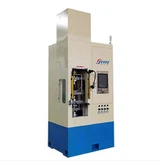
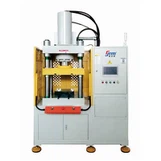
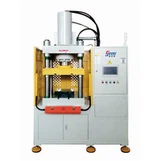
As a supplier of Hydraulic Servo Presses, I often receive inquiries from customers about the power consumption of these machines. Understanding the power consumption of a Hydraulic Servo Press is crucial for businesses, as it directly impacts operational costs and energy efficiency. In this blog post, I will delve into the factors that influence the power consumption of a Hydraulic Servo Press and provide insights to help you make informed decisions.
How a Hydraulic Servo Press Works
Before we discuss power consumption, it's essential to understand how a Hydraulic Servo Press operates. A Hydraulic Servo Press uses a hydraulic system to generate force, and a servo motor controls the movement of the hydraulic pump. This combination allows for precise control of the press's speed, force, and position, making it suitable for a wide range of applications, including metal forming, stamping, and assembly.
The servo motor in a Hydraulic Servo Press adjusts its speed and torque based on the press's requirements. When the press is idle or operating at low loads, the servo motor consumes less power. As the load increases, the servo motor ramps up its power output to meet the demand. This dynamic control of the motor's power consumption is one of the key advantages of a Hydraulic Servo Press over traditional hydraulic presses.
Factors Affecting Power Consumption
Several factors influence the power consumption of a Hydraulic Servo Press. Let's take a closer look at each of these factors:
1. Press Size and Capacity
The size and capacity of a Hydraulic Servo Press play a significant role in determining its power consumption. Larger presses with higher tonnage capacities generally require more power to operate. This is because they need to generate more force to perform the intended tasks, which in turn requires a larger hydraulic pump and a more powerful servo motor.
For example, a small Hydraulic Servo Press with a capacity of 10 tons may consume around 3 - 5 kilowatts (kW) of power during operation. In contrast, a large press with a capacity of 500 tons could consume upwards of 50 kW or more. When selecting a press, it's important to choose the right size and capacity for your specific application to avoid over - sizing, which can lead to unnecessary power consumption.
2. Cycle Time and Frequency
The cycle time and frequency of the press also impact power consumption. Cycle time refers to the time it takes for the press to complete one full cycle of operation, including the pressing stroke, return stroke, and any dwell time. A shorter cycle time means the press is operating more frequently, which can increase power consumption.
If a press is running continuously at a high cycle frequency, the servo motor will be constantly adjusting its speed and torque, leading to higher power usage. On the other hand, if the press has a longer cycle time or operates intermittently, the power consumption will be lower. It's important to optimize the cycle time based on your production requirements to balance productivity and energy efficiency.
3. Load Profile
The load profile of the press, or the amount of force required during each cycle, is another critical factor. If the press is operating under a constant high load, the servo motor will need to maintain a high power output, resulting in increased power consumption. However, if the load varies throughout the cycle, the servo motor can adjust its power output accordingly, reducing overall power usage.
For instance, in a stamping application where the press only needs to apply high force during the actual stamping process and low force during the return stroke, the servo motor can operate at a lower power level during the return stroke, saving energy.
4. System Efficiency
The efficiency of the hydraulic system and the servo motor also affects power consumption. A well - designed and maintained hydraulic system with minimal leakage and efficient components will consume less power. Similarly, a high - efficiency servo motor can convert electrical energy into mechanical energy more effectively, reducing power losses.
Regular maintenance of the press, including checking for hydraulic leaks, replacing worn - out components, and ensuring proper lubrication, can help improve system efficiency and reduce power consumption.
Calculating Power Consumption
Calculating the power consumption of a Hydraulic Servo Press can be complex, as it depends on multiple factors. However, a rough estimate can be made using the following steps:
- Determine the motor power rating: The power rating of the servo motor is usually specified by the manufacturer in kilowatts (kW). This is the maximum power the motor can consume under full load.
- Estimate the average load factor: The load factor is the ratio of the average load on the press to its maximum load capacity. Based on the load profile of your application, estimate the average load factor. For example, if the press operates at an average load of 50% of its maximum capacity, the load factor is 0.5.
- Consider the cycle time and frequency: Determine the cycle time and the number of cycles per hour. Multiply the motor power rating by the load factor and the duty cycle (the ratio of the time the press is actually operating to the total time) to get an estimate of the average power consumption.
For example, if a press has a motor power rating of 10 kW, an average load factor of 0.6, and a duty cycle of 0.8 (80% of the time the press is operating), the estimated average power consumption would be 10 kW x 0.6 x 0.8 = 4.8 kW.
Energy - Saving Measures
As a supplier of Hydraulic Servo Presses, we are committed to helping our customers reduce their energy consumption. Here are some energy - saving measures that can be implemented:


1. Optimize Press Design
Choose a press with a design that is optimized for energy efficiency. This may include features such as variable - speed pumps, energy - recovery systems, and advanced control algorithms that adjust the motor's power output based on the load.
2. Implement Energy - Saving Modes
Many modern Hydraulic Servo Presses come with energy - saving modes that can be activated during periods of low activity. These modes reduce the power consumption of the press by lowering the motor speed or putting the press into a standby mode.
3. Upgrade Components
Consider upgrading old or inefficient components, such as the hydraulic pump or the servo motor, to more energy - efficient models. Newer technologies often offer better performance and lower power consumption.
4. Train Operators
Proper training of operators can also contribute to energy savings. Operators should be educated on how to operate the press efficiently, including optimizing the cycle time, avoiding unnecessary idling, and using the energy - saving features of the press.
Conclusion
The power consumption of a Hydraulic Servo Press is influenced by several factors, including press size and capacity, cycle time and frequency, load profile, and system efficiency. By understanding these factors and implementing energy - saving measures, businesses can reduce their operational costs and improve their environmental footprint.
At our company, we offer a wide range of Hydraulic Servo Presses designed to meet the diverse needs of our customers. Our presses are known for their high performance, precision, and energy efficiency. In addition to Hydraulic Servo Presses, we also provide C Frame Electric Servo Press and Servo Mechanical Press options.
If you are interested in learning more about our products or need help in selecting the right press for your application, please feel free to contact us. Our team of experts is ready to assist you in making an informed decision and ensuring that you get the most out of your investment.
References
- "Hydraulic Press Technology Handbook", Industrial Press Inc.
- "Servo Motor and Drive Systems: Fundamentals and Applications", Peter Nachtwey.