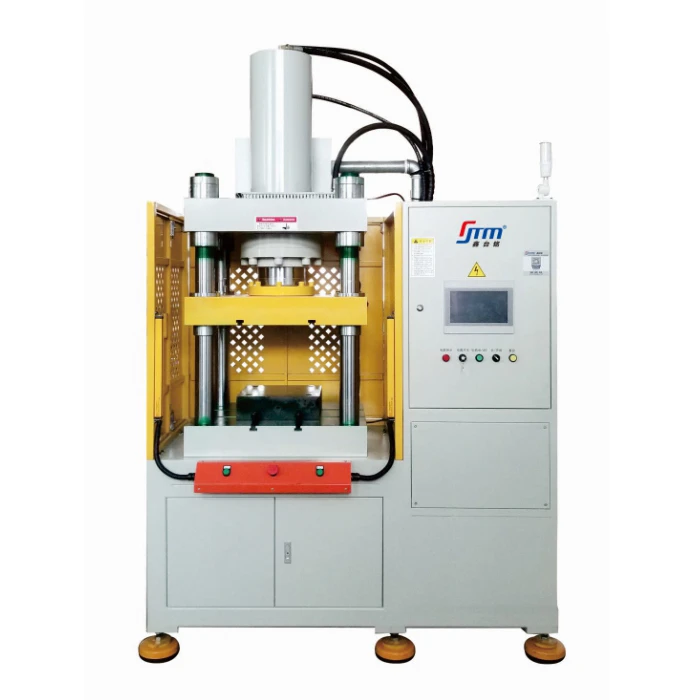
As a supplier of Small Hydraulic Press, I've encountered numerous inquiries from customers regarding the measurement of the force exerted by these machines. Understanding the force of a hydraulic press is crucial for ensuring its safe and efficient operation, as well as for selecting the appropriate press for a specific application. In this blog post, I'll share some practical methods for measuring the force of a small hydraulic press.

Understanding the Basics of Hydraulic Presses
Before delving into the measurement techniques, it's essential to have a basic understanding of how hydraulic presses work. A hydraulic press operates on the principle of Pascal's law, which states that when pressure is applied to a confined fluid, the pressure change occurs uniformly throughout the entire fluid.
In a hydraulic press, a small force applied to a small piston creates a pressure in the hydraulic fluid. This pressure is then transmitted to a larger piston, which generates a much larger force. The relationship between the forces applied to the pistons is determined by the ratio of their areas. Mathematically, this can be expressed as:
[F_2 = \frac{A_2}{A_1} \times F_1]
Where:
- (F_1) is the force applied to the small piston
- (A_1) is the area of the small piston
- (F_2) is the force exerted by the large piston
- (A_2) is the area of the large piston
Methods for Measuring the Force of a Small Hydraulic Press
1. Using a Load Cell
A load cell is a transducer that converts a force into an electrical signal. It's one of the most accurate and reliable methods for measuring the force of a hydraulic press.
Steps:
- Select an appropriate load cell: Choose a load cell with a capacity that exceeds the maximum force expected to be exerted by the hydraulic press. For example, if you're using a 20 Ton Hydraulic Press, you might select a load cell with a capacity of 25 tons or more.
- Install the load cell: Place the load cell between the ram of the hydraulic press and the workpiece. Make sure the load cell is properly aligned and secured to ensure accurate measurement.
- Connect the load cell to a data acquisition system: The data acquisition system will receive the electrical signal from the load cell and convert it into a readable force value. You can use a digital display or a computer software to record and analyze the data.
- Perform the measurement: Operate the hydraulic press to apply force to the load cell. The data acquisition system will display the force value in real-time. Take multiple measurements at different force levels to ensure accuracy.
2. Pressure Gauge Method
If you don't have access to a load cell, you can estimate the force of the hydraulic press using a pressure gauge. This method relies on the relationship between pressure and force in a hydraulic system.
Steps:
- Locate the pressure gauge: Most hydraulic presses are equipped with a pressure gauge that measures the pressure in the hydraulic fluid. Make sure the pressure gauge is properly calibrated.
- Determine the piston area: Measure the diameter of the large piston and calculate its area using the formula (A = \pi \times (\frac{d}{2})^2), where (d) is the diameter of the piston.
- Calculate the force: Use the formula (F = P \times A), where (P) is the pressure reading on the gauge and (A) is the area of the large piston. For example, if the pressure gauge reads 1000 psi and the area of the large piston is 10 square inches, the force exerted by the press is (F = 1000 \text{ psi} \times 10 \text{ in}^2 = 10,000 \text{ lbs}).
3. Using a Calibrated Weighing Scale
In some cases, you can use a calibrated weighing scale to measure the force of a hydraulic press. This method is suitable for small-scale presses with relatively low forces.
Steps:
- Select a suitable weighing scale: Choose a weighing scale with a capacity that can handle the maximum force expected to be exerted by the hydraulic press.
- Place the weighing scale: Position the weighing scale under the ram of the hydraulic press. Make sure the scale is level and stable.
- Perform the measurement: Operate the hydraulic press to apply force to the weighing scale. The scale will display the weight, which is equivalent to the force exerted by the press. Take multiple measurements at different force levels to ensure accuracy.
Factors Affecting Force Measurement
When measuring the force of a small hydraulic press, it's important to consider several factors that can affect the accuracy of the measurement.
1. Hydraulic Fluid Viscosity
The viscosity of the hydraulic fluid can affect the pressure distribution in the system, which in turn can affect the force measurement. Higher viscosity fluids may cause increased pressure losses, resulting in a lower measured force.
2. Friction
Friction in the hydraulic system, such as between the pistons and the cylinders, can also affect the force measurement. Friction can cause energy losses, resulting in a lower measured force.
3. Temperature
The temperature of the hydraulic fluid can affect its viscosity, which can in turn affect the pressure distribution in the system. Higher temperatures can cause the fluid to become less viscous, resulting in a higher measured force.
4. Calibration
To ensure accurate force measurement, it's essential to calibrate the measuring equipment regularly. This includes the load cell, pressure gauge, and weighing scale. Calibration ensures that the equipment provides accurate and reliable readings.
Importance of Accurate Force Measurement
Accurate force measurement is crucial for several reasons:
1. Safety
Knowing the exact force exerted by the hydraulic press is essential for ensuring the safety of the operators and the equipment. Overloading the press can cause damage to the machine and pose a safety hazard.
2. Quality Control
Accurate force measurement is important for maintaining consistent quality in the manufacturing process. By controlling the force applied to the workpiece, you can ensure that the products meet the required specifications.
3. Equipment Selection
When selecting a hydraulic press for a specific application, it's important to know the required force. Accurate force measurement can help you choose the right press with the appropriate capacity.
Conclusion
Measuring the force of a small hydraulic press is an important aspect of ensuring its safe and efficient operation. By using methods such as load cells, pressure gauges, or calibrated weighing scales, you can accurately determine the force exerted by the press. It's also important to consider the factors that can affect the measurement accuracy and to calibrate the measuring equipment regularly.
If you're in the market for a small hydraulic press or need more information about force measurement, feel free to contact us. We're a leading supplier of Small Hydraulic Press, 50 Ton Press Cylinder, and 20 Ton Hydraulic Press, and we're committed to providing high-quality products and excellent customer service. Our team of experts can help you select the right press for your application and provide guidance on force measurement and other related topics.
References
- Smith, J. (2018). Hydraulic Press Technology. New York: Industrial Press.
- Jones, A. (2019). Measuring Forces in Hydraulic Systems. Journal of Hydraulic Engineering, 45(2), 123 - 135.
- Brown, R. (2020). Safety Considerations for Hydraulic Presses. Manufacturing Safety Review, 30(3), 45 - 56.