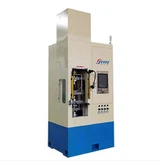
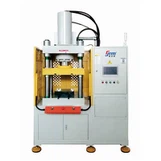
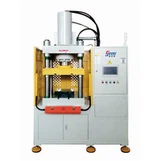
Hey there! As a supplier of hydraulic presses, I've seen firsthand how crucial it is to keep these machines cool. Hydraulic presses are workhorses in many industries, from manufacturing to automotive repair. But when they overheat, it can lead to all sorts of problems, like reduced efficiency, increased wear and tear, and even breakdowns. So, let's dive into the different cooling methods for hydraulic presses.
Air Cooling
One of the simplest and most common cooling methods is air cooling. It's exactly what it sounds like – using air to dissipate heat from the hydraulic system. Air-cooled systems typically consist of a radiator and a fan. The radiator has a series of fins that increase the surface area for heat transfer. The fan blows air over the radiator, carrying away the heat.
Air cooling is great because it's relatively inexpensive and easy to maintain. You don't need a complex plumbing system like you do with water cooling. Plus, it's portable, which is a big plus if you need to move your hydraulic press around. However, it's not as efficient as water cooling, especially in hot environments. If your press is working hard in a high-temperature area, air cooling might not be enough to keep it at the right temperature.
Water Cooling
Water cooling is a more efficient way to cool a hydraulic press. It works by circulating water through a heat exchanger, which absorbs the heat from the hydraulic fluid. The heated water is then pumped out of the press and cooled down in a separate cooling tower or chiller before being recirculated.
There are two main types of water cooling systems: open-loop and closed-loop. In an open-loop system, the water is taken from a source like a river or a well, used to cool the press, and then discharged back into the environment. This type of system is simple and inexpensive, but it can be wasteful of water and might not be allowed in some areas due to environmental regulations.


A closed-loop system, on the other hand, recirculates the same water over and over again. It uses a cooling tower or a chiller to remove the heat from the water. Closed-loop systems are more expensive to set up, but they're more water-efficient and better for the environment.
Water cooling is ideal for high-powered hydraulic presses that generate a lot of heat. It can keep the press at a stable temperature, even under heavy loads. But it does require more maintenance than air cooling. You need to make sure the water is clean and free of contaminants to prevent corrosion and blockages in the system.
Oil Cooling
Oil cooling is another option for hydraulic presses. In this method, the hydraulic oil itself is used as a coolant. The oil is circulated through a heat exchanger, where it gives up its heat to a cooling medium, usually water or air.
Oil cooling has some advantages. Since the oil is already part of the hydraulic system, there's no need for a separate coolant. This can simplify the design and reduce the cost of the cooling system. Oil also has good lubricating properties, which can help to reduce wear and tear on the hydraulic components.
However, oil cooling has its limitations. The cooling capacity of oil is lower than that of water, so it might not be suitable for very high-powered presses. Also, the oil can degrade over time, especially if it's exposed to high temperatures for long periods. This can lead to a decrease in its cooling efficiency and an increase in the risk of component failure.
Refrigeration Cooling
Refrigeration cooling is the most advanced and efficient cooling method for hydraulic presses. It uses a refrigeration cycle to remove heat from the hydraulic fluid. The system consists of a compressor, a condenser, an expansion valve, and an evaporator.
The compressor compresses the refrigerant gas, raising its temperature and pressure. The hot gas then flows through the condenser, where it gives up its heat to the surrounding air or water. The condensed refrigerant then passes through the expansion valve, which reduces its pressure and temperature. The cold refrigerant then flows through the evaporator, where it absorbs heat from the hydraulic fluid.
Refrigeration cooling can maintain a very precise temperature, even in extreme conditions. It's ideal for applications where temperature control is critical, such as in the aerospace and electronics industries. However, it's also the most expensive cooling method, both in terms of initial cost and operating cost.
Which Cooling Method is Right for You?
So, how do you choose the right cooling method for your hydraulic press? Well, it depends on several factors.
First, consider the power and heat generation of your press. If you have a small, low-power press, air cooling might be sufficient. But if you have a large, high-powered press that operates continuously under heavy loads, you'll probably need a more efficient cooling method like water cooling or refrigeration cooling.
Next, think about the environment in which your press will be operating. If it's in a hot, humid area, air cooling might not be enough. You might need to use water cooling or refrigeration cooling to keep the press at a safe temperature.
Also, consider your budget. Air cooling is the cheapest option, both in terms of initial cost and operating cost. Water cooling is more expensive, but it's more efficient. Refrigeration cooling is the most expensive, but it offers the best temperature control.
Finally, think about the maintenance requirements. Air cooling is the easiest to maintain, while water cooling and refrigeration cooling require more regular maintenance.
Conclusion
As a hydraulic press supplier, I know how important it is to choose the right cooling method for your machine. Whether you're using air cooling, water cooling, oil cooling, or refrigeration cooling, make sure it's the right fit for your press and your operating conditions.
If you're in the market for a hydraulic press or need help choosing the right cooling system, don't hesitate to reach out. We offer a wide range of hydraulic presses, including Fast Hydraulic Press, 20 Ton Floor Press, and Customized Hydraulic Press. Our team of experts can help you find the perfect solution for your needs.
Let's work together to keep your hydraulic press running cool and efficient!
References
- "Hydraulic Systems: Design, Installation, and Maintenance" by Joseph E. Shigley
- "Fluid Power with Applications" by Anthony Esposito