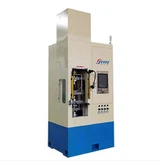
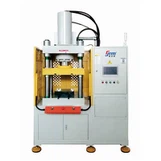
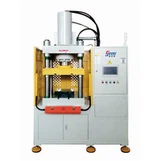
Hot hydraulic presses are essential equipment in various industries, offering unique capabilities for shaping, molding, and processing materials under high pressure and temperature. As a supplier of hot hydraulic presses, I am excited to share insights into the different types of these powerful machines and their applications.
1. Single - Action Hot Hydraulic Presses
Single - action hot hydraulic presses are among the most basic yet widely used types. These presses operate with a single ram that moves in one direction, typically downward, to apply pressure on the workpiece. The heating element in a single - action hot hydraulic press can be integrated into the platens, which are the flat surfaces that come into contact with the material.
The simplicity of the single - action design makes it suitable for a variety of applications, such as compression molding of plastics and rubber. For instance, in the production of plastic parts, the heated platens soften the plastic material, and the downward force of the ram shapes it into the desired form. Single - action hot hydraulic presses are also used in the manufacturing of composite materials, where layers of fibers and resins are pressed together under heat and pressure to create strong, lightweight components.
If you are looking for a compact and straightforward solution for small - scale production, you might be interested in our Small Hydraulic Press, which can be configured as a single - action hot press.
2. Double - Action Hot Hydraulic Presses
Double - action hot hydraulic presses offer more complex functionality compared to single - action presses. They feature two rams: a main ram and a blank holder ram. The main ram applies the primary force for shaping the material, while the blank holder ram holds the edges of the workpiece in place during the forming process.
This dual - ram design is particularly useful in deep - drawing operations, where a flat sheet of material is transformed into a three - dimensional shape, such as a cup or a container. The blank holder ram prevents wrinkling and tearing of the material by maintaining a consistent tension around the edges. In industries such as automotive and aerospace, double - action hot hydraulic presses are used to manufacture parts with complex geometries. The heating system in these presses ensures that the material remains malleable during the forming process, reducing the risk of cracking or deformation.
Our Hot Hydraulic Press range includes double - action models that are engineered for high - precision and efficient production.
3. Four - Column Hot Hydraulic Presses
Four - column hot hydraulic presses are known for their high stability and large working area. As the name suggests, these presses are supported by four vertical columns, which provide a rigid structure to withstand the high forces generated during operation. The platens in a four - column press are usually larger, allowing for the processing of bigger workpieces.
These presses are commonly used in industries such as metal forging and large - scale composite manufacturing. In metal forging, the high - pressure and high - temperature capabilities of the four - column hot hydraulic press can reshape metal billets into complex shapes, improving the mechanical properties of the final product. In composite manufacturing, the large working area enables the production of large - size composite panels, which are used in the construction of aircraft wings, wind turbine blades, and other structural components.
The four - column design also allows for easy access to the working area, facilitating the loading and unloading of workpieces. This makes the press suitable for automated production lines, where efficiency and productivity are crucial.
4. Electric Over Hydraulic Presses
Electric Over Hydraulic Presses combine the advantages of electric and hydraulic systems. These presses use an electric motor to drive a hydraulic pump, which in turn generates the pressure required for operation. The electric control system provides precise control over the press's movement, speed, and pressure, allowing for highly accurate and repeatable processes.
One of the key benefits of electric over hydraulic presses is their energy efficiency. The electric motor only consumes power when the press is in operation, reducing energy waste compared to traditional hydraulic presses that run the pump continuously. Additionally, these presses produce less noise and vibration, creating a more comfortable working environment.
In applications such as precision stamping, injection molding, and powder compacting, the precise control offered by electric over hydraulic presses ensures high - quality products. The heating elements in these presses can be precisely regulated to maintain the optimal temperature for the material being processed.
5. Frame - Type Hot Hydraulic Presses
Frame - type hot hydraulic presses are designed with a robust frame structure that encloses the working area. This design provides excellent protection for the operator and the equipment, as well as reducing the risk of external interference. The frame also helps to distribute the forces evenly across the press, enhancing its stability and durability.
These presses are often used in industries where safety and precision are of utmost importance, such as the medical device manufacturing and electronics industries. In medical device manufacturing, frame - type hot hydraulic presses are used to produce components with high precision and cleanliness requirements. The enclosed frame prevents dust and contaminants from entering the working area, ensuring the quality of the final product. In the electronics industry, these presses are used for processes such as chip encapsulation and circuit board lamination, where precise temperature and pressure control are essential.


Applications and Considerations
The choice of a hot hydraulic press depends on several factors, including the type of material to be processed, the required force and temperature, the size of the workpiece, and the production volume. For example, if you are working with small - sized parts and low - volume production, a single - action or small - scale hot hydraulic press might be sufficient. On the other hand, if you are involved in large - scale manufacturing of complex parts, a four - column or double - action press could be more appropriate.
It is also important to consider the maintenance and operating costs of the press. Electric over hydraulic presses generally have lower energy consumption and maintenance requirements, which can result in long - term cost savings. Additionally, the heating system of the press should be reliable and easy to maintain, as it plays a crucial role in the quality of the final product.
Conclusion
In conclusion, there are various types of hot hydraulic presses available, each with its own unique features and applications. As a supplier, we are committed to providing high - quality hot hydraulic presses that meet the diverse needs of our customers. Whether you are a small - scale manufacturer or a large - scale industrial enterprise, we can help you find the right press for your specific requirements.
If you are interested in learning more about our hot hydraulic presses or would like to discuss your procurement needs, please feel free to reach out to us. Our team of experts is ready to assist you in selecting the most suitable press and providing comprehensive support throughout the entire process.
References
- Callister, W. D., & Rethwisch, D. G. (2010). Materials Science and Engineering: An Introduction. Wiley.
- Dieter, G. E. (1986). Mechanical Metallurgy. McGraw - Hill.