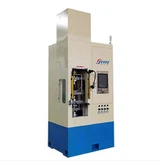
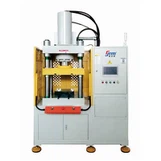
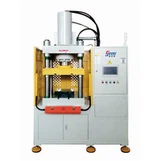
In the realm of industrial machinery, the 20 Ton Hydraulic Press stands as a cornerstone of efficiency and precision. As a dedicated supplier of this remarkable equipment, I am often asked about the automation level of a 20 Ton Hydraulic Press. In this blog post, I will delve into the intricacies of its automation capabilities, exploring the features, benefits, and applications that make it an indispensable tool in various industries.
Understanding the Basics of a 20 Ton Hydraulic Press
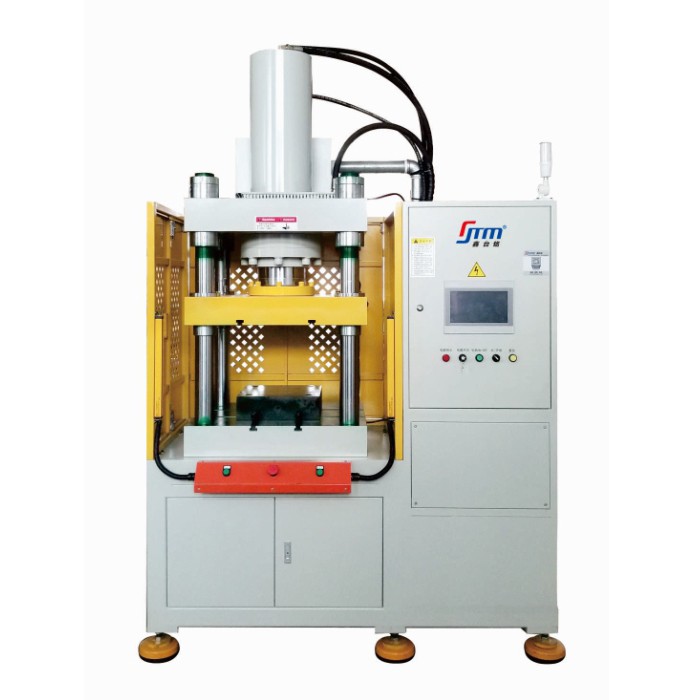
Before we discuss the automation level, it's essential to understand the fundamental operation of a 20 Ton Hydraulic Press. At its core, a hydraulic press uses hydraulic cylinders to generate a compressive force of up to 20 tons. This force is applied to a workpiece placed between the press's platens, allowing for a wide range of operations such as punching, bending, forming, and assembly.
The hydraulic system, which consists of a hydraulic pump, valves, and cylinders, is the heart of the press. It converts mechanical energy into hydraulic energy, which is then used to move the cylinders and apply the necessary force. The control system, on the other hand, manages the operation of the press, including the speed, pressure, and position of the cylinders.
Automation Levels in 20 Ton Hydraulic Presses
The automation level of a 20 Ton Hydraulic Press can vary significantly depending on the specific model and its intended application. Generally, hydraulic presses can be classified into three main automation levels: manual, semi - automatic, and fully automatic.
Manual Hydraulic Presses
Manual hydraulic presses are the most basic type of hydraulic presses. They require an operator to perform most of the tasks, such as loading and unloading the workpiece, setting the pressure and stroke, and activating the press. While these presses are relatively simple and inexpensive, they are also less efficient and more labor - intensive. Manual presses are typically used in small - scale operations or for tasks that require a high degree of operator control.
Semi - Automatic Hydraulic Presses
Semi - automatic hydraulic presses offer a higher level of automation compared to manual presses. In a semi - automatic press, some functions are automated, while others still require operator intervention. For example, the press may automatically apply the set pressure and stroke, but the operator is responsible for loading and unloading the workpiece. Semi - automatic presses are suitable for medium - volume production runs, where a balance between automation and operator control is required.
Fully Automatic Hydraulic Presses
Fully automatic hydraulic presses are the most advanced type of hydraulic presses. They are capable of performing all tasks, from loading and unloading the workpiece to applying the correct pressure and stroke, without any operator intervention. These presses are equipped with advanced control systems, sensors, and robotic arms that can handle complex operations with high precision and repeatability. Fully automatic presses are ideal for high - volume production runs, where efficiency and productivity are of utmost importance.
Features and Benefits of Automated 20 Ton Hydraulic Presses
Automated 20 Ton Hydraulic Presses come with a range of features that enhance their performance and productivity. Here are some of the key features and benefits:
Precision and Repeatability
Automated presses use advanced control systems and sensors to ensure precise control of the pressure, speed, and position of the cylinders. This results in consistent and accurate results, even for complex operations. The repeatability of automated presses is particularly important in industries such as automotive, aerospace, and electronics, where tight tolerances are required.
Increased Productivity
By eliminating the need for manual intervention, automated presses can significantly increase productivity. They can operate continuously without breaks, reducing the cycle time and increasing the output. Additionally, automated presses can be integrated with other production equipment, such as conveyors and robotic arms, to create a seamless production line.
Safety
Automated presses are designed with safety in mind. They are equipped with safety sensors and guards that prevent accidents and injuries. For example, if an operator tries to access the press while it is in operation, the sensors will detect the presence of the operator and stop the press immediately.
Flexibility
Automated presses can be programmed to perform a wide range of operations, making them highly flexible. They can be easily reconfigured to accommodate different workpiece sizes and shapes, allowing for quick changeovers between production runs.
Applications of 20 Ton Hydraulic Presses
The 20 Ton Hydraulic Press, with its various automation levels, finds applications in a multitude of industries.
Manufacturing
In the manufacturing industry, 20 Ton Hydraulic Presses are used for tasks such as stamping, forming, and assembly. They can be used to produce a wide range of products, from small metal parts to large automotive components. For example, in the production of electronic devices, a hydraulic press can be used to assemble the delicate components with high precision.
Metalworking
In metalworking, hydraulic presses are used for cutting, bending, and forging metal sheets and bars. The 20 Ton Hydraulic Press is suitable for medium - sized metalworking operations, where a moderate amount of force is required. It can be used to create complex shapes and profiles, making it an essential tool in the metal fabrication process.
Woodworking
In the woodworking industry, hydraulic presses are used for tasks such as laminating, veneering, and pressing wood panels. The press can apply a uniform pressure across the surface of the wood, ensuring a strong and durable bond.
Related Products and Their Automation
As a supplier, we also offer other types of hydraulic presses that may be of interest to our customers. For instance, the Hydraulic Line Press is designed specifically for working on hydraulic lines, with varying levels of automation to suit different needs. The 50 Ton Hydraulic Press provides a higher force capacity and can be automated for more heavy - duty applications. And the Electric Hydraulic Press for Blacksmithing is tailored for the blacksmithing industry, with features that enhance the automation of the forging process.

Contact Us for Procurement and Consultation
If you are interested in learning more about the 20 Ton Hydraulic Press or any of our other products, we encourage you to contact us. Our team of experts is ready to assist you in selecting the right press for your specific application, whether you need a manual, semi - automatic, or fully automatic model. We can also provide detailed information on the features, benefits, and pricing of our products. By working with us, you can ensure that you get a high - quality hydraulic press that meets your production requirements and budget.
References
- "Hydraulic Press Technology Handbook", Industrial Press Inc.
- "Automation in Manufacturing Processes", McGraw - Hill Education