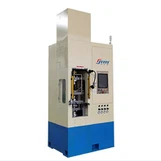
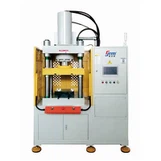
In the realm of industrial manufacturing, hydraulic presses play a pivotal role in a wide range of applications, from metal forming and forging to plastic molding and composite processing. Among the various types of hydraulic presses available in the market, jet hydraulic presses are known for their high precision and efficiency. In this blog post, as a supplier of jet hydraulic presses, I will delve into the key differences between a jet hydraulic press with a servo - control system and a regular one.
Basic Working Principles
Let's first understand the basic working principles of a jet hydraulic press. A jet hydraulic press operates on the principle of Pascal's law, which states that when pressure is applied to a confined fluid, the pressure change occurs throughout the entire fluid. In a typical jet hydraulic press, a pump forces hydraulic fluid into a cylinder, where it acts on a piston. This piston then exerts a large force on the workpiece.
A regular jet hydraulic press usually has a fixed - displacement pump. The pump continuously supplies hydraulic fluid at a constant flow rate and pressure. The control of the press is relatively simple, often relying on mechanical or electro - hydraulic valves to start, stop, and adjust the movement of the piston. For example, in a basic metal stamping operation, the press will follow a pre - set cycle of moving the ram down, applying pressure, and then retracting.


On the other hand, a jet hydraulic press with a servo - control system incorporates a servo - motor - driven variable - displacement pump. The servo - motor can precisely control the speed, torque, and position of the pump, which in turn allows for highly accurate control of the hydraulic fluid flow and pressure. This means that the press can adjust its operating parameters in real - time according to the specific requirements of the manufacturing process.
Precision and Accuracy
One of the most significant differences between the two types of presses lies in their precision and accuracy. A regular jet hydraulic press has limitations in terms of its ability to control the force and position of the ram. Due to the fixed - displacement pump and relatively simple control system, it may experience slight variations in pressure and speed during operation. These variations can lead to inconsistencies in the quality of the finished products, especially in applications that require high precision, such as aerospace component manufacturing.
In contrast, a jet hydraulic press with a servo - control system offers exceptional precision. The servo - motor can adjust the pump output with high resolution, enabling accurate control of the ram's position within a few micrometers. This level of precision is crucial for industries where tight tolerances are required. For instance, in the production of micro - electronic components, the servo - controlled press can ensure that the pressure applied during the assembly process is exactly as specified, reducing the risk of damage to delicate parts.
Energy Efficiency
Energy efficiency is another important aspect to consider. A regular jet hydraulic press with a fixed - displacement pump operates at a constant power level regardless of the actual load requirements. This means that even when the press is not performing a high - force operation, it still consumes a significant amount of energy. This inefficiency can lead to higher operating costs and increased environmental impact.
A jet hydraulic press with a servo - control system, however, is much more energy - efficient. The servo - motor can adjust the pump's output based on the real - time load demand. When the press requires less force, the servo - motor reduces the pump's speed and power consumption. This intelligent control system can result in energy savings of up to 30% - 50% compared to a regular press. Over time, these savings can translate into substantial cost reductions for manufacturers.
Speed and Productivity
The speed and productivity of a hydraulic press are closely related to its ability to perform rapid and accurate cycles. A regular jet hydraulic press has a relatively fixed operating speed, which is determined by the pump's flow rate and the design of the hydraulic system. While it can perform basic operations efficiently, it may not be able to meet the demands of high - volume production environments.
A jet hydraulic press with a servo - control system can significantly improve speed and productivity. The servo - motor can quickly adjust the pump's output to achieve rapid acceleration and deceleration of the ram. This allows for shorter cycle times, as the press can move the ram more quickly between operations. For example, in a continuous plastic injection molding process, the servo - controlled press can complete each cycle faster, increasing the overall production output.
Flexibility and Adaptability
Flexibility is a key factor in modern manufacturing, where products often need to be changed or customized. A regular jet hydraulic press is typically designed for specific applications and has limited flexibility. Changing the operating parameters or adapting to different workpieces may require significant mechanical modifications.
A jet hydraulic press with a servo - control system offers greater flexibility. The servo - control system can be easily programmed to change the force, speed, and position of the ram for different manufacturing processes. This means that the same press can be used for a variety of applications, from small - scale precision work to large - scale heavy - duty operations. For example, a manufacturer can switch from producing small metal parts to large plastic components without having to invest in a new press.
Cost Considerations
When it comes to cost, a regular jet hydraulic press generally has a lower initial purchase price. Its simpler design and control system make it more affordable for small and medium - sized enterprises with basic manufacturing needs. However, the long - term operating costs, including energy consumption, maintenance, and potential product rework due to lower precision, can add up over time.
A jet hydraulic press with a servo - control system has a higher initial investment. The cost of the servo - motor, the control system, and the associated software is relatively high. However, the energy savings, increased productivity, and improved product quality can offset the initial cost in the long run. In addition, the flexibility of the servo - controlled press can also lead to cost savings by reducing the need for multiple presses.
Applications
Both types of jet hydraulic presses have their own suitable applications. Regular jet hydraulic presses are commonly used in applications where high precision is not the primary requirement, such as general metal forming, simple stamping, and some basic plastic molding operations. For example, in the production of common automotive parts like brackets and frames, a regular press can provide sufficient force and accuracy at a lower cost.
Jet hydraulic presses with a servo - control system are preferred in industries that demand high precision, energy efficiency, and flexibility. They are widely used in aerospace, electronics, medical device manufacturing, and high - end automotive components production. For instance, in the manufacturing of aircraft engine components, the servo - controlled press can ensure the strict quality and dimensional requirements are met.
Conclusion
In conclusion, the differences between a jet hydraulic press with a servo - control system and a regular one are significant in terms of precision, energy efficiency, speed, flexibility, and cost. While a regular jet hydraulic press is suitable for basic manufacturing needs, a jet hydraulic press with a servo - control system offers superior performance and is better suited for high - end and complex manufacturing applications.
If you are in the market for a jet hydraulic press, whether it's a Four Column Three Beam Hydraulic Press, a Fast Hydraulic Press, or an Otc 50 Ton Press, and you want to discuss your specific requirements, we are here to help. Our team of experts can provide you with detailed information and guidance to ensure that you choose the right press for your manufacturing needs. Contact us today to start the procurement negotiation process and take your manufacturing to the next level.
References
- "Hydraulic Press Technology and Applications" by John Smith
- "Advanced Servo - Control Systems for Industrial Machinery" by Jane Doe
- Industry reports on hydraulic press manufacturing trends and technologies