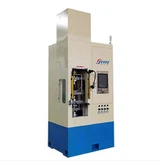
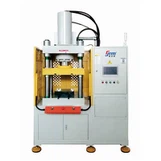
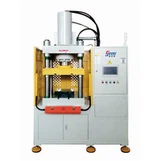
Hey there! As a supplier of Servo Hydraulic Press Machines, I often get asked about the difference between servo hydraulic press machines and pneumatic press machines. So, I thought I'd write this blog to break it down for you in a simple and easy - to - understand way.
Let's start with the basics. A pneumatic press machine uses compressed air to generate force. It's like a big air - powered muscle that can push or press things. On the other hand, a servo hydraulic press machine, well, as the name suggests, it combines servo technology with hydraulic power. It uses a hydraulic system to generate force, and the servo part helps in precise control.
Power and Force
One of the most obvious differences between the two is the amount of force they can generate. Pneumatic press machines are generally limited in the amount of force they can produce. Compressed air has its limitations, and usually, pneumatic presses are used for lighter - duty applications. For example, they're great for tasks like stamping thin sheets of metal, inserting small parts, or doing light assembly work.
In contrast, servo hydraulic press machines can generate a much higher amount of force. The hydraulic system can handle high pressures, allowing these presses to be used for heavy - duty operations. If you need to forge large metal parts, perform deep drawing of thick materials, or do any other high - force application, a servo hydraulic press machine is the way to go. For instance, in the automotive industry, servo hydraulic presses are used to form large body panels and engine components.
Precision and Control
When it comes to precision, servo hydraulic press machines have a clear edge. The servo control system in these presses allows for extremely accurate control of the press stroke, speed, and force. You can set the press to stop at a specific position with high precision, which is crucial for applications where tight tolerances are required. For example, in the manufacturing of electronic components, a high level of precision is needed to ensure proper fit and function. You can check out our High Precision Servo Press for more details on this kind of precision.


Pneumatic press machines, while they can offer some level of control, are not as precise as servo hydraulic presses. The nature of compressed air makes it a bit more difficult to achieve the same level of accuracy. The air pressure can fluctuate slightly, and the response time might not be as fast as a servo - controlled system. However, for applications where a lower level of precision is acceptable, pneumatic presses can still do a great job.
Speed and Efficiency
In terms of speed, pneumatic press machines are generally faster in their operation. Compressed air can be quickly released and re - pressurized, allowing for rapid cycling. This makes them ideal for high - volume, low - force applications where speed is of the essence. For example, in a factory that produces thousands of small plastic parts per day, a pneumatic press can keep up with the production demand.
Servo hydraulic press machines, although they might not be as fast as pneumatic presses in terms of cycling speed, offer better efficiency in other ways. The ability to precisely control the force and stroke means that less energy is wasted. In a servo hydraulic press, the system only uses the amount of power needed for the specific task at hand. This can lead to significant energy savings over time, especially for applications that require a lot of force.
Cost
Cost is always an important factor when choosing a press machine. Pneumatic press machines are generally less expensive to purchase. They have a simpler design and use compressed air, which is a relatively inexpensive power source. The initial investment for a pneumatic press is lower, making it a more budget - friendly option for small businesses or those with limited capital.
Servo hydraulic press machines, on the other hand, are more expensive upfront. The servo control system and the hydraulic components add to the cost. However, when you consider the long - term benefits such as energy savings, higher precision, and the ability to handle heavy - duty applications, the return on investment can be quite high. If you're in an industry where quality and precision are key, the extra cost of a servo hydraulic press can be well worth it.
Maintenance
Maintenance is another aspect to consider. Pneumatic press machines are relatively easy to maintain. They have fewer moving parts compared to servo hydraulic presses, and the main maintenance task usually involves checking the air supply system for leaks and ensuring proper lubrication of the moving parts.
Servo hydraulic press machines require more maintenance. The hydraulic system needs to be regularly checked for fluid levels, leaks, and the quality of the hydraulic fluid. The servo control system also needs to be calibrated and maintained to ensure accurate operation. However, with proper maintenance, a servo hydraulic press can have a long service life and continue to perform at a high level.
Applications
As mentioned earlier, pneumatic press machines are commonly used in light - duty applications such as light assembly, small - part stamping, and inserting operations. They're also popular in industries like plastics manufacturing, electronics assembly, and the production of small consumer goods.
Servo hydraulic press machines have a wider range of applications. They're used in heavy industries such as automotive, aerospace, and metal forging. They can also be used in precision manufacturing processes where high accuracy is required. Our H Frame Electric Servo Press and Hydraulic Servo Press are designed to meet the diverse needs of different industries.
In conclusion, the choice between a servo hydraulic press machine and a pneumatic press machine depends on your specific requirements. If you need a low - cost, fast - cycling machine for light - duty tasks, a pneumatic press might be the right choice. But if you require high force, precision, and efficiency for heavy - duty or high - precision applications, a servo hydraulic press machine is the better option.
If you're interested in learning more about our servo hydraulic press machines or have any questions about which press is right for your business, feel free to reach out. We're here to help you make the best decision for your manufacturing needs.
References
- "Press Machine Handbook", Industrial Press Inc.
- "Manufacturing Engineering and Technology", S. Kalpakjian and S. Schmid.