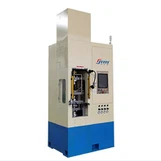
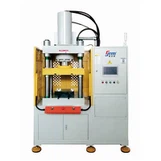
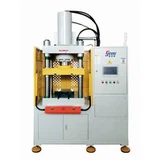
Hey there! As a supplier of Jet Hydraulic Presses, I often get asked about the difference between vertical and horizontal Jet Hydraulic Presses. So, I thought I'd write this blog to clear up any confusion and help you understand which type might be the best fit for your needs.
Let's start with the basics. A hydraulic press is a machine that uses hydraulic cylinders to generate a compressive force. Jet Hydraulic Presses are known for their reliability, efficiency, and high - performance. You can check out our range of Jet Hydraulic Press on our website.
Vertical Jet Hydraulic Press
A vertical Jet Hydraulic Press is, as the name suggests, oriented vertically. The ram, which is the moving part that applies the force, moves up and down. This design has several advantages.
One of the main benefits of a vertical press is its space - efficiency. It takes up less floor space compared to a horizontal press, making it a great option for smaller workshops or facilities where space is at a premium. For example, if you have a tight corner in your workshop, a vertical press can be easily installed there without causing much disruption to the overall layout.


Vertical presses are also very versatile. They can be used for a wide range of applications, such as stamping, punching, bending, and assembly. Whether you're working on small parts or larger components, a vertical Jet Hydraulic Press can handle the job. Take our 20 Ton Benchtop Press for instance. It's a vertical press that's perfect for light - duty jobs and can be placed right on your workbench.
Another advantage is the ease of loading and unloading workpieces. Since the ram moves vertically, it's often easier to position the workpiece on the press table. You can simply place the part on the table and start the operation. This makes the workflow more efficient, especially when you're dealing with a high volume of parts.
However, vertical presses do have some limitations. One of the main issues is the height restriction. If you're working with very tall workpieces, you might run into problems as the vertical travel of the ram might not be sufficient. Also, for some applications that require a long - stroke movement, a vertical press might not be the best choice.
Horizontal Jet Hydraulic Press
Now, let's talk about horizontal Jet Hydraulic Presses. In a horizontal press, the ram moves horizontally. This design offers its own set of unique advantages.
One of the biggest advantages of a horizontal press is its ability to handle long and heavy workpieces. Since the ram moves horizontally, there's no height restriction like in a vertical press. You can easily press, straighten, or assemble long shafts, pipes, or other elongated components. For example, if you're in the manufacturing industry and need to work on large - scale structural parts, a horizontal press can be a game - changer. Our 55 Ton Hydraulic Press is a great example of a horizontal press that can handle heavy - duty jobs.
Horizontal presses are also well - suited for applications that require a long - stroke movement. The horizontal orientation allows for a longer ram travel, which is useful for processes like extrusion or forming operations that need a large amount of movement.
In terms of stability, horizontal presses can offer better support for heavy workpieces. The horizontal design distributes the weight of the workpiece more evenly across the press structure, reducing the risk of tipping or instability during operation.
But just like vertical presses, horizontal presses have their drawbacks. They typically take up more floor space, which can be a problem if you have limited space in your workshop. Also, loading and unloading workpieces can be a bit more challenging, especially for larger and heavier parts. You might need additional equipment, such as cranes or forklifts, to move the workpieces onto and off the press.
Which One Should You Choose?
So, how do you decide between a vertical and a horizontal Jet Hydraulic Press? Well, it all comes down to your specific needs and requirements.
If you have limited space, need a versatile press for a variety of small - to - medium - sized jobs, and value ease of loading and unloading, a vertical press is probably the way to go. It's a cost - effective and practical solution for many workshops.
On the other hand, if you're dealing with long, heavy, or large - scale workpieces, need a long - stroke movement, and have enough floor space, a horizontal press would be a better fit. It offers superior performance for specific types of applications.
In conclusion, both vertical and horizontal Jet Hydraulic Presses have their own strengths and weaknesses. As a supplier, we're here to help you make the right choice. If you're still unsure about which press is best for your business, don't hesitate to reach out to us. Our team of experts can provide you with more detailed information and guidance based on your specific needs. Whether you're a small - scale manufacturer or a large industrial facility, we have the right Jet Hydraulic Press for you. So, if you're interested in purchasing a Jet Hydraulic Press, get in touch with us today and let's start the conversation about how we can meet your pressing needs!
References
- "Hydraulic Press Handbook", Industrial Press Inc.
- Technical manuals of Jet Hydraulic Presses.