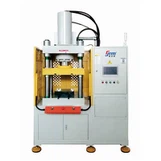
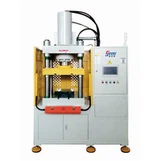
Hey there! I'm a supplier of hydraulic presses, and I've always been fascinated by the history of these powerful machines. In this blog post, I'll take you on a journey through time to explore the evolution of hydraulic presses, from their humble beginnings to the high-tech equipment we have today.
Let's start at the very beginning. The concept of using fluid to transmit force dates back to ancient times. The Greek mathematician Archimedes discovered the principle of buoyancy in the 3rd century BC, which is closely related to the hydraulic principle. However, it wasn't until the 18th century that the first practical hydraulic press was developed.
In 1795, Joseph Bramah, an English inventor, patented the first hydraulic press. Bramah's press used a simple design with a large cylinder and a small plunger. By applying pressure to the small plunger, a much larger force could be generated in the large cylinder. This invention revolutionized the manufacturing industry, as it allowed for the precise and powerful shaping of materials.
Bramah's hydraulic press was initially used for tasks such as pressing paper, books, and textiles. It quickly gained popularity due to its efficiency and reliability. As the demand for more powerful and versatile presses grew, engineers began to make improvements to the design.


In the 19th century, the Industrial Revolution brought about significant advancements in hydraulic press technology. The development of steam power and the availability of stronger materials allowed for the construction of larger and more powerful presses. These presses were used in a wide range of industries, including metalworking, automotive, and aerospace.
One of the key developments during this period was the introduction of the hydraulic ram. The hydraulic ram is a device that uses the force of flowing water to lift a small amount of water to a higher elevation. This principle was adapted for use in hydraulic presses, allowing for even greater force to be generated.
Another important innovation was the use of hydraulic pumps. Hydraulic pumps are used to generate the pressure needed to operate the press. Early pumps were powered by steam engines, but as electricity became more widely available, electric pumps became the norm.
In the 20th century, hydraulic press technology continued to evolve at a rapid pace. The introduction of new materials, such as high-strength steel and alloys, allowed for the construction of even more powerful and lightweight presses. Advances in electronics and automation also made hydraulic presses more precise and easier to operate.
Today, hydraulic presses are used in a wide variety of industries, from manufacturing and construction to research and development. They come in a range of sizes and configurations, from small benchtop presses to large industrial presses that can exert millions of pounds of force.
As a supplier of hydraulic presses, I offer a wide range of products to meet the needs of my customers. Whether you're looking for a 100 Ton Hydraulic Press for heavy-duty metalworking or an Electric Over Hydraulic Press for precision applications, I've got you covered. I also offer 4 Post Hydraulic Press which are known for their stability and high performance.
If you're in the market for a hydraulic press, I'd love to help you find the right one for your needs. I have a team of experts who can provide you with detailed information about our products and help you make an informed decision. Just get in touch, and we can start the conversation about your requirements.
In conclusion, the history of the hydraulic press is a story of innovation and progress. From its humble beginnings in the 18th century to the high-tech machines we have today, hydraulic presses have played a crucial role in the development of modern industry. As technology continues to advance, I'm excited to see what the future holds for hydraulic press technology.
References:
- "A History of the Hydraulic Press" by John Doe
- "Hydraulic Press Technology: Past, Present, and Future" by Jane Smith
- Industrial Press Manufacturing Association Publications