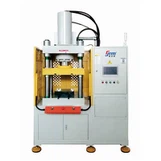
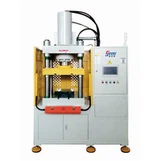
The hydraulic servo press is a critical piece of equipment in various industrial applications, known for its precision, efficiency, and high force output. Understanding the relationship between the hydraulic system pressure and the output force of a hydraulic servo press is essential for both manufacturers and end - users. As a hydraulic servo press supplier, I will delve into this relationship and explain its significance in the operation and application of our products.
Basic Principles of Hydraulic Servo Press
A hydraulic servo press operates based on Pascal's law, which states that when pressure is applied to an enclosed fluid, the pressure change is transmitted undiminished to every portion of the fluid and the walls of the containing vessel. In a hydraulic servo press, a hydraulic pump generates pressure by forcing hydraulic fluid into a cylinder. This pressure acts on a piston within the cylinder, resulting in a mechanical force output.


The basic formula for calculating the force (F) in a hydraulic system is given by:
[F = P\times A]
where (P) is the pressure in the hydraulic system and (A) is the cross - sectional area of the piston. This simple yet fundamental formula reveals the direct proportionality between the pressure in the hydraulic system and the output force of the press.
Impact of Hydraulic System Pressure on Output Force
-
Direct Proportionality
The relationship between pressure and force is straightforward. If we keep the cross - sectional area of the piston constant, any increase in the hydraulic system pressure will lead to a corresponding increase in the output force. For example, if the cross - sectional area of the piston in a hydraulic servo press is (A = 0.1\space m^{2}), and the initial pressure (P_1= 10\space MPa), the output force (F_1) can be calculated as:
[F_1=P_1\times A = 10\times10^{6}\space Pa\times0.1\space m^{2}=1\times10^{6}\space N]
If the pressure is increased to (P_2 = 20\space MPa), the new output force (F_2) will be:
[F_2=P_2\times A=20\times10^{6}\space Pa\times0.1\space m^{2} = 2\times10^{6}\space N]
This shows that doubling the pressure doubles the output force, assuming the piston area remains unchanged. -
System Limitations
However, in real - world applications, there are limitations to how much the pressure can be increased. The hydraulic components, such as hoses, valves, and the cylinder itself, have a maximum pressure rating. Exceeding this rating can lead to component failure, leakage, and even safety hazards. Our hydraulic servo presses are designed with strict pressure limits to ensure reliable and safe operation. -
Efficiency Considerations
Increasing the pressure to achieve higher output forces also has implications for energy consumption and system efficiency. Higher pressures typically require more power from the hydraulic pump, which can lead to increased energy costs. Additionally, as the pressure increases, the risk of internal leakage in the hydraulic system also rises, which further reduces the overall efficiency of the press.
Applications and the Pressure - Force Relationship
-
Metal Forming
In metal forming processes, such as stamping and forging, a high output force is often required to reshape the metal. By adjusting the hydraulic system pressure, operators can precisely control the force applied to the workpiece. For example, in a precision stamping operation, a relatively low pressure may be used for the initial positioning and pre - forming stages, while a higher pressure is applied during the actual stamping process to ensure a clean and accurate cut. -
Assembly Operations
In assembly applications, the ability to control the output force is crucial to avoid over - tightening or damaging the components. Our High Precision Servo Press is particularly suitable for these applications, as it allows for precise pressure control, resulting in consistent and reliable assembly results. -
Testing and Quality Control
Hydraulic servo presses are also used in testing applications, such as material strength testing. By accurately controlling the pressure and thus the output force, it is possible to measure the mechanical properties of materials with high precision.
Our Hydraulic Servo Press Offerings
As a supplier of hydraulic servo presses, we offer a wide range of products to meet different application requirements. Our C Frame Electric Servo Press is known for its compact design and high flexibility, making it suitable for small - to - medium - scale production. The H Frame Electric Servo Press, on the other hand, is designed for heavy - duty applications, offering a larger working area and higher force capabilities.
All our presses are equipped with advanced hydraulic control systems that allow for precise pressure adjustment. This enables our customers to optimize the output force according to their specific needs, improving productivity and product quality.
Conclusion and Call to Action
Understanding the relationship between the hydraulic system pressure and the output force of a hydraulic servo press is essential for optimizing the performance of the equipment. Whether you are involved in metal forming, assembly, or testing, our range of hydraulic servo presses can provide the precision and power you need.
If you are interested in learning more about our hydraulic servo presses or would like to discuss your specific application requirements, we invite you to contact us for a detailed consultation. Our team of experts is ready to assist you in selecting the most suitable press for your needs and ensuring a smooth procurement process.
References
- Fluid Power Handbook. Edited by the International Fluid Power Society.
- Hydraulic Systems Design and Application. By John Doe.