


What Is C Frame Press?
Also referred to as gap-frame presses, C-frame presses get their name thanks to the press's C-like shape.A C-frame press is open on three sides so it can easily handle a variety of material sizes and shapes. C-frame presses are frequently used in manufacturing processes because they facilitate easy part loading and unloading for manual workers and automated solutions.The basic C-frame press design consists of three components: a welded steel framework, a hydra-pneumatic cylinder or servo actuator, and upper and lower platens.
Advantages of C Frame Press
Versatility in manufacturing processes: C frame presses can perform various operations, including punching, bending, and stamping, which makes them a versatile tool for many industries.
Space-saving design: C frame presses have a compact footprint, which makes them ideal for small manufacturing spaces. They also require less floor space than other types of presses, such as straight side presses or OBI presses.
Ease of use and maintenance: C frame presses are easy to operate and maintain, which reduces downtime and increases productivity.
Precision and accuracy in operations: C frame presses have a stable frame that provides greater accuracy and precision during operations, resulting in higher-quality products.
Reduced production time and costs: C frame presses can perform multiple operations in one machine, which reduces the need for additional equipment and speeds up production time, resulting in cost savings.

Fast hydraulic press uses a liquid pressure of 2-20MPA as the power source, and is externally connected to a three-phase AC380V 50HZ or two-phase AC220 60HZ AC power supply

55 ton hydraulic press is suitable for the processing of metal, plastic, rubber, wood, powder and other products. It is commonly used in pressing and forming processes, such as forging, stamping, cold extrusion, straightening, bending, flanging, sheet metal deep drawing, powder metallurgy, and pressing.

50 Ton Electric Hydraulic Press
A 50 ton electric hydraulic press is a mechanical equipment that uses an electric motor to drive, convert electrical energy into hydraulic energy, and then generate pressure through a hydraulic cylinder to achieve material forming and processing. Its efficient, precise, and safe characteristics make it widely used in industries such as light industry, food, shoemaking, lighting, electrical appliances, toys, hardware equipment, furniture, etc.

Four Column Three Beam Hydraulic Press
Four column three beam hydraulic press is a hydraulic mechanical equipment that adopts a four column and three plate structure. It uses a hydraulic system to achieve compression, which has the characteristics of simple operation, high pressure, and good stability. It mainly consists of oil cylinders, guide pillars, guide sleeves, movable plates, workbenches, and other parts.

Efficient design: Jet Hydraulic Press adopts a unique spraying technology that can quickly and effectively inject high-pressure liquid into the working area that needs to be processed, greatly improving work efficiency.
Accurate control: Through a precise control system, it is possible to ensure accurate control of the pressure and flow rate of the liquid during the spraying process, thereby achieving precise processing results.

50 ton pressure is a mechanical equipment that can generate 50 tons of pressure. This type of press is widely used in various production and manufacturing processes that require precise control and the application of a large amount of pressure.

Electric Over Hydraulic Press is a molding equipment that combines electric drive and hydraulic transmission technology. It uses an electric motor to drive a hydraulic pump, converting electrical energy into hydraulic energy, and then converting hydraulic energy into mechanical energy through a hydraulic cylinder, achieving process operations such as pressing, forming, stretching, and bending of workpieces.
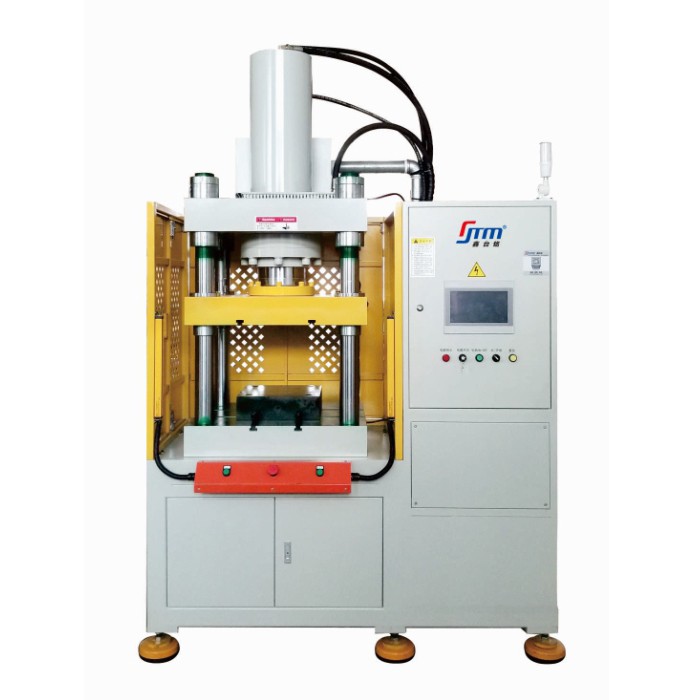
Electric Hydraulic Press for Blacksmithing
Electric Hydraulic Press for Blacksmith is an electric hydraulic press designed specifically for blacksmiths. This device combines electric drive and hydraulic transmission technology to provide efficient and accurate solutions for processes such as forging, pressing, and bending of metal materials.

75 ton hydraulic press is a high-performance mechanical equipment mainly used for pressing and forming processes of materials such as metal, plastic, rubber, etc.
Our factory
Shenzhen xintaiming intelligent equipment co., ltd. Was established in 2008 and is a manufacturer of precision press equipment and intelligent systems with nearly 20 years of experience in the hydraulic equipment industry.
Advanced equipment
Having multiple production equipment, such as high-precision cnc machine tools, large water mills, precision carving machines, cutting machines, milling machines, etc.
High quality
Our products are manufactured to very high standards, using the finest materials and manufacturing processes.
Customized services
According to customer needs and scenarios, to provide personalized customized program to meet the special needs of customers.
24h online service
We try and respond to all concerns within 24 hours and our teams are always at your disposal in case of any emergencies.
Types of C Frame Press
Hydraulic Power Press
These types of Power presses use two cylinders for moving the top shaft or beam. These are pretty dependable and accurate.
Mechanical Press
These types are more popular compared to others. Their speed is greater, and they are also quite precise.
Pneumatic Power Press
This type of machine uses air pressure for energy supply.
Electric Power Press
In this type of machine, a motor exerts pressure.
Application of C Frame Press
In the automotive sector, gap frame presses are pivotal in forming metal parts. Some common parts formed with a c-frame press in the automotive industry include engine mounts and seat frames. The press machines are also used for assembly as well as to stake components together.
Industrial manufacturing relies on heavy duty machinery to be able to manufacture intricate parts and assemblies. They often use c-frame presses to make items like spring clips and forklift parts.
Stamping: A press tool, referred to as a die, is used to shape the parts from the inserted sheet metal. The ram then pushes the sheet metal through the die creating the required shape.
Assembly: Fastening two or more parts together with a hydraulic assembly press.
Bending: Straining material, usually flat sheet or strip metal, by moving it around a straight axis and applying stress. The bend is permanently set after removal of the applied stress.
Blanking: Cutting out a piece of metal and then retaining that piece of metal.
Coining: Highly compressing all surfaces of a workpiece within a closed-die system.
Compaction: An object produced by the compression of powdered material, typically done with a custom hydraulic compaction press.
Crimping: An assembly technique that uses a custom assembly press and appropriate tool to fold and flatten material so that two pieces are securely fastened together by pinching action. This technique is commonly used to join sheet metal parts.
Draw and deep draw work: Pulling metal through a tapered die and stretching the metal into a thinner shape.
Embossing: A process using a custom hydraulic press that creates imprinted designs in sheet material by means of male and female dies, theoretically with no change in metal thickness.
Forming: Converting a flat sheet metal workpiece into a 3-d part.
Piercing: Cutting or punching an opening, such as a hole in sheet material, plate or various parts with a hydraulic c-frame floor press.
Press fitting: Assembling parts with an interference fit.
Staking: A method using a custom assembly press to permanently fasten two pieces of parts together by recessing one piece within the other and causing plastic flow of the material at the joint.
Straightening: Bending, twisting, or stretching to correct any deviation from straightness in bars, tubes, or similar long parts or shapes.
Trimming: Typically, a secondary cutting or shearing operation on a previously formed, drawn or forged part. The goal is to "trim" any surplus metal off the edges, bringing the part to the desired shape and size.
The electronics sector often demands small and intricate parts. C-frame press machines are the perfect machine to help manufacture these components due to the high levels of accuracy they can achieve. Manufacturers commonly use these presses to produce components like electronic connectors and various computer parts.
Drilling and mining industries employ the c-frame (complete with savage's custom straightening accessories) to straighten shafts and tubulars as well as flats, bars, and special components.
The defense industry uses huge c-frame presses with pre-stressed frames to bend steel plate for ship building. The navy also employs c-frame presses for on-board applications at sea.
Components of C Frame Press


Ram
The ram is a moving component that applies force to the workpiece through its connection to the drive mechanism. It is responsible for carrying the upper die (or punch). In a gap frame press, the ram moves vertically, delivering the required pressure for stamping, bending, or shaping the material.
Bed
The bed is the stationary part of the press upon which the material or workpiece is placed. The bed supports the workpiece during the pressing operation. It is typically made from high-strength steel to withstand the forces exerted during the press cycle. It is a flat, machined surface that typically supports the lower bolster and dies.
Slide
"Slide" is another term for "ram." The slide refers to the component that moves vertically, carrying the upper die towards the workpiece and the lower die.
Frame
The frame supports all the components of the press, including the ram, bed, and slide. In gap frame presses, the frame is characterized by its open "C" shape, offering good accessibility to the work area from three sides.
Controls
Controls refer to the operating system of the press, which can be manual, semi-automatic, or fully automatic. Modern gap frame presses are equipped with sophisticated control systems that allow for precise operation. These controls can regulate pressure, speed, and stroke length, among other parameters.
Tooling
Tooling refers to the upper and lower dies that work in conjunction to shape or cut the material. The upper die is customarily called the "punch," and some operations require only a die, others only a punch. The design of the tooling dictates the specific operation performed by the press.
Safety Features
Safety features are crucial in press operations to protect the operator from accidents. These may include light curtains, dual control buttons requiring both hands to operate the press, and emergency stop features. These features ensure operator safety during press operation.
Lubrication System
The lubrication system ensures that moving parts of the press, such as the ram, are adequately lubricated to reduce friction and wear. Proper lubrication is essential for the longevity of the press and for smooth operation.
Bolster Plate
The bolster plate is a thick, flat steel plate that sits on top of the bed. It provides a stable and level surface for mounting the bottom die or tooling. The bolster plate may have T-slots or holes for securing the dies in place.
Hydraulic or Mechanical System
Gap frame presses can be either hydraulic, mechanical, or servo-motor driven. Hydraulic presses use fluid pressure to move the ram, offering precise control over force application. Mechanical presses rely on a motor, flywheel, and clutch to drive the ram, typically achieving higher speeds. Some servo-motor presses do not have any hydraulic system, in others, the servo motors use hydraulics to transfer power.
How to Maintain C Frame Press
Check for oil leaks on all hydraulic lines. A small leak can turn into a big mess. Tighten leaky fittings and wipe off excess oil. Keeping a press clean will help pinpoint new leaks and keep the press running cooler.
Check the oil level and. If necessary, top it off. Most presses have an oil tag listing the type of oil needed.
Check for loose bolts around the tooling area. Some dies can cause press vibration and shock, which loosen bolts.
Check lubrication on guided platens. Some bushings have fittings that should be greased to maintain a thin lubrication film over the rod. Do not overgrease because this causes dirt to accumulate, causing the bearing to wear prematurely.
Check the oil temperature. When the press has reached its normal operating temperature, check the oil temperature. It should be around 120 degrees f.
Check the ram. A press's ram should be moist but not dripping oil .
Check light curtains. One way to do this is to break the beam while the ram is traveling down. The press should stop immediately. Breaking the beam on the upstroke might not stop the press.
How to Choose a C Frame Press
Needs
Before seeking out the best prices, you should consider the role a hydraulic press will have in your personal shop or business. Writing a full list of tasks you'd like a press to accomplish can provide a better scope of the strength, size, type, model, etc. Of press you will need. Be sure to understand what a hydraulic press can do; the range of abilities are extensive.
Tonnage
After considering the uses for your press, the next important question to ask is what tonnage will be required for the jobs. If you are switching from a mechanical press to a hydraulic press, the tonnage requirements will not change. Do consider, however, when choosing the right hydraulic press, you only need to know the maximum tonnage you will require for any given job. Opposed to a mechanical press, most hydraulic presses can be tuned down to a lower tonnage depending on the task.
The required tonnage to punch material (or the punching force) varies depending on three factors: Perimeter of the punch, shear strength of the material, and material thickness.
Accessories and tooling
Most modern hydraulic presses come standard with many features such as dwell timers, automatic cycling, distance reversal limit switches, and light curtains. However, some presses come equipped with a wide variety of additional controls and features that can greatly improve the productivity and usability of the machine. Choosing a more equipped machine is a more expensive investment, however it may save you or your business time and money in the long run.
How the C Frame Press Works
A C frame press operates by converting energy into force to cut or shape materials captured between a punch and a die. In mechanical gap frame presses, an electric motor powers a flywheel that stores kinetic energy. Energy from the motor is transferred to the press's ram through a clutch and crankshaft mechanism, converting the flywheel's rotational energy into the linear motion of the ram. As the ram moves up and down, it presses the attached tooling or die against the workpiece on the press bed, performing such operations as punching, bending, or forming. After completing the cycle, the clutch disengages, and the ram returns to its starting position, often assisted by a counterbalance mechanism.
Our Factory
The company's headquarters is located in Longgang District, Shenzhen, with a factory area of over 10000 square meters. In 2014, Jiangxi Xintaiming Intelligent Technology Co., Ltd. was established as a production base with a self built factory of over 40000 square meters in Fuzhou High tech Zone, Jiangxi.
Our Certificate
We have 5 invention patents, 53 utility model patents, 3 appearance patents, and 20 software copyrights, and have been awarded the National High tech Enterprise Certificate, ISO9001 Quality Management System Certification, and ISO14001 Environmental Management System Certification. We have independent export qualifications.


FAQ
Hot Tags: c frame press, China c frame press manufacturers, suppliers, factory, Customized Hydraulic Press, hydraulic press discussions, hydraulic press specifications, hydraulic press suppliers, hydraulic press presentations, affordable hydraulic press


