


What Is Hot Hydraulic Press?
A hot hydraulic press is a type of heat press machine that uses hydraulic pressure to apply heat and pressure onto various substrates, such as fabrics, metals, plastics, rubber, and wood. It utilizes the static pressure of a liquid, typically oil, to shape, deform, and configure these materials.
The mechanism of a hot hydraulic press consists of a mainframe, power system, and controls. The heating element, usually a heated upper platen, applies heat to the substrate, while the lower platen provides pressure. The heat press machine allows for easy press and operation, with selectable heating-up speed and adjustable pressure head to ensure even pressure distribution.
Advantages of Hot Hydraulic Press
1. Adopting four columns and three plate structures, the movable plate is parallel to the table and has high precision.
2. The hot hydraulic press adopts pulse heating technology. Its temperature control is precise, and the temperature sampling frequency is 0.1s.
3. Single working platform, rotating working platform, left and right moving platform, and other diversified working modes.
4. Easy design of oil pressure circuit, small horsepower demand, easy maintenance.
5. Safety guarantee, two-hand start button, emergency rise (emergency stop) switch, imported safety hand grating, and three-sided seal safety door.
6. According to the production process requirements, the hot hydraulic press machine can be installed under the top cylinder or left and right clamping cylinder (back feeding cylinder). The electronic control system can be configured according to the requirements; our hot hydraulic press machine can accept non-standard customization.
7. It is very fast in use, making the work much more efficient. If the thickness of the work does not exceed twenty millimeters, then the time required for heat conduction with this hot hydraulic press is very short. The thickness of the workpiece has a great influence on ordinary conduction heating. While using the hot hydraulic press machine, the thickness of the workpiece has very little influence on the heating.
8. When using the machine to heat the work, it can make the heated workpiece heated better. The hot hydraulic press can heat evenly both the inside and outside of the product, thus making the quality of the workpiece very good. The workpiece itself does not generate too much heat, it can make the adhesive curing strength to be improved.
9. Nowadays, there is a very high demand for environmental protection. The hot hydraulic pressing machine is eco-friendly and it ensures both hygiene and safety under the premise of obtaining a good heating effect.

20 Ton Electric Hydraulic Press
The 20 ton electric hydraulic press is a hydraulic equipment that integrates efficiency, accuracy, and safety. It adopts electric drive combined with hydraulic transmission technology to achieve high-precision control and large tonnage pressing. This equipment is widely used in various industries such as light industry, food, shoemaking, lighting, electrical appliances, toys, hardware equipment, furniture, etc. It is particularly suitable for various sheet metal forming processing, pressing, die-cutting and other operations.

The 50 ton hydraulic press is a powerful and compact hydraulic forming equipment. It adopts advanced hydraulic transmission technology, converts mechanical energy into liquid pressure energy through hydraulic pumps, and then uses hydraulic cylinders to transfer pressure to the workpiece, achieving various material pressing, forming, stretching, bending and other process operations.

Electric Over Hydraulic Press is a molding equipment that combines electric drive and hydraulic transmission technology. It uses an electric motor to drive a hydraulic pump, converting electrical energy into hydraulic energy, and then converting hydraulic energy into mechanical energy through a hydraulic cylinder, achieving process operations such as pressing, forming, stretching, and bending of workpieces.

50 ton pressure is a mechanical equipment that can generate 50 tons of pressure. This type of press is widely used in various production and manufacturing processes that require precise control and the application of a large amount of pressure.

Efficient design: Jet Hydraulic Press adopts a unique spraying technology that can quickly and effectively inject high-pressure liquid into the working area that needs to be processed, greatly improving work efficiency.
Accurate control: Through a precise control system, it is possible to ensure accurate control of the pressure and flow rate of the liquid during the spraying process, thereby achieving precise processing results.

75 ton hydraulic press is a high-performance mechanical equipment mainly used for pressing and forming processes of materials such as metal, plastic, rubber, etc.
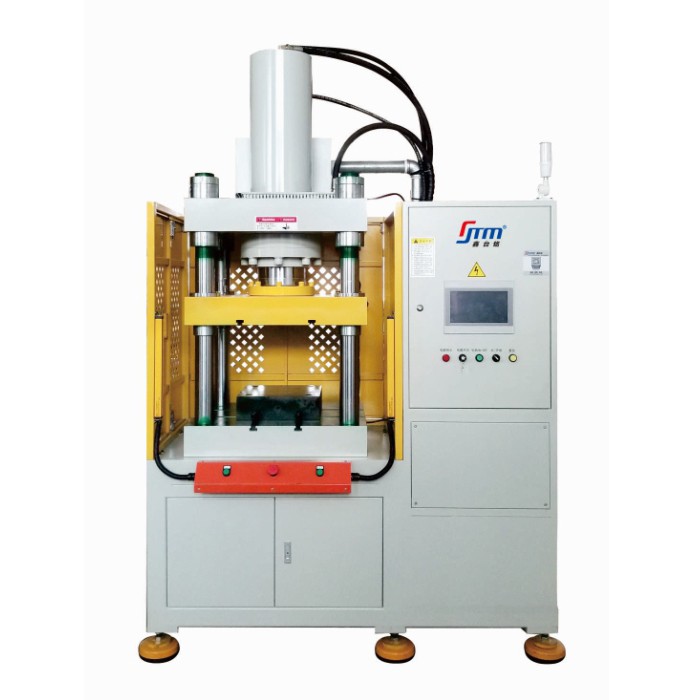
Electric Hydraulic Press for Blacksmithing
Electric Hydraulic Press for Blacksmith is an electric hydraulic press designed specifically for blacksmiths. This device combines electric drive and hydraulic transmission technology to provide efficient and accurate solutions for processes such as forging, pressing, and bending of metal materials.

Four Column Three Beam Hydraulic Press
Four column three beam hydraulic press is a hydraulic mechanical equipment that adopts a four column and three plate structure. It uses a hydraulic system to achieve compression, which has the characteristics of simple operation, high pressure, and good stability. It mainly consists of oil cylinders, guide pillars, guide sleeves, movable plates, workbenches, and other parts.

50 Ton Electric Hydraulic Press
A 50 ton electric hydraulic press is a mechanical equipment that uses an electric motor to drive, convert electrical energy into hydraulic energy, and then generate pressure through a hydraulic cylinder to achieve material forming and processing. Its efficient, precise, and safe characteristics make it widely used in industries such as light industry, food, shoemaking, lighting, electrical appliances, toys, hardware equipment, furniture, etc.
Our factory
Shenzhen xintaiming intelligent equipment co., ltd. Was established in 2008 and is a manufacturer of precision press equipment and intelligent systems with nearly 20 years of experience in the hydraulic equipment industry.
Advanced equipment
Having multiple production equipment, such as high-precision cnc machine tools, large water mills, precision carving machines, cutting machines, milling machines, etc.
High quality
Our products are manufactured to very high standards, using the finest materials and manufacturing processes.
Customized services
According to customer needs and scenarios, to provide personalized customized program to meet the special needs of customers.
24h online service
We try and respond to all concerns within 24 hours and our teams are always at your disposal in case of any emergencies.
Types of Hot Hydraulic Press
Hydraulic press brake: This machine is used for bending sheet metal, and it is one of the most popular machines in this category. Its hydraulic system applies force to a metal sheet, causing it to form into the required shape. A hydraulic press brake is ideal for metal fabrication shops and is commonly used in the construction industry.
Hydraulic guillotine shear: Also known as a lever shearer, this type of machine is used to cut metal sheets with high precision. The shearing action is achieved by the downward force applied to a blade when it is brought into contact with the metal. Hydraulic guillotine shears are often found in workshops where quick and accurate cuts are necessary.
Hydraulic plate vulcanizing press: This specialized hydraulic press is used in the process of conveyor belt manufacturing. It applies heat and pressure to splice or repair belts, creating a continuous loop that is crucial for conveying products efficiently.
Hydraulic hole punching machine: To create holes in sheet metal, a hydraulic hole punching machine uses a punch and die set. The press applies force around the edge of the hole being punched to cut through the material cleanly.
Application of Hot Hydraulic Press
Forging and metalworking:
In the metalworking industry, a hot hydraulic press is crucial for forging operations. Forging involves shaping metal by applying compressive force while the metal is heated to a specific temperature. This process improves the metal's mechanical properties and ensures a precise shape. The hydraulic press provides the necessary force and can maintain the required temperature, making it ideal for this application.
Plastic molding:
In plastic manufacturing, hot hydraulic presses are used to mold plastics into various shapes. The heat softens the plastic, making it more pliable, and the high pressure from the press molds it into the desired form. This process is essential for producing items like automotive parts, household goods, and packaging materials.
Composite material processing:
Hot hydraulic presses are also used in the processing of composite materials. These materials, often made from a combination of fibers and resins, require specific temperature and pressure conditions to cure properly. The press ensures uniform pressure and temperature distribution, critical for the integrity and strength of the final product.
Laboratory applications:
In scientific and research settings, hot hydraulic presses are used to prepare samples for analysis. The controlled temperature and pressure allow researchers to manipulate materials in a precise manner, which is essential for experiments and testing.
Industrial and commercial applications:
Beyond manufacturing, hot hydraulic presses are used in various industrial and commercial settings for tasks such as compacting waste materials, forming rubber seals, and pressing laminates. The ability to control both pressure and temperature makes these presses versatile and valuable in numerous applications.
Review and correction:
The provided information is accurate and aligns with the typical uses of a hot hydraulic press. The explanation covers the key industries and applications where such presses are essential, highlighting their role in shaping materials under controlled thermal conditions.
Components of Hot Hydraulic Press
Titanium indenter
Ensures even temperature distribution, fast heat-up, and long service life.
Adjustable pressure head
Allows for even pressure application on components, crucial for uniform processing.
Digital pressure gauge
Provides precise control over the pressure range, enhancing the machine's accuracy and reliability.
Heat plate
Made of solid longitudinal drilled steel plate, ensuring good precision and durability. The heating system is designed in sections to minimize heat consumption and ensure uniform heat conduction.
How to Maintain Hot Hydraulic Press
Dust
Make sure to dust your hot hydraulic press on a regular basis. Try to avoid getting to the point where it is visually obvious that your hot hydraulic press needs a dusting. Built up dust can make the machine run hotter. Make sure to keep dust off both the exterior and interior components of your hot hydraulic press.
Lubrication
To lubricate your hot hydraulic press, use a high heat and extreme pressure lubricant or a white grease and apply it to the pistons and rods of your hot hydraulic press. This will help the lowering and lifting of the platens become a smoother motion. Apply the lubricant with either a cotton swab or a rag. You should only need to do this about once a year. However, depending on how often you use your hot hydraulic press, it's certainly okay to do it more than once a year.
Clean upper platen
A well-functioning platen, is a clean platen! Use a lint free cloth to wipe the top of your platen with iron cleaner, alcohol, mineral spirits, or a simple green/water mix. Before you start cleaning, make sure your platen is cool, to eliminate the chances of burning anything. You should clean your upper platen at least every couple of weeks, but the frequency will depend on what you're pressing and how frequently.
Rubber pad / lower platen
When the surface of your lower platen is cracked, dented, punctured, warped, chipped, or deformed in anyway, it may be time to replace it. Replacing a lower platen or even just the rubber pad is much cheaper than replacing the whole heat press. Transfers need a flat and smooth surface to ensure even pressure, and when the surface is deformed, even pressure is hard to maintain.
Cord
It is always important to use the correct cord. If you replace the cord that came with the hot hydraulic press, be sure to replace it with a chord that can handle the appropriate amount of voltage/wattage. If it's replaced with a cord with a smaller gauge or is a thinner cord, it could become a fire hazard.
Use heat press sheets/covers
To protect your platens and make them last longer, use heat press sheets. These sheets comes in a variety of forms that can be used in different ways. They act like a mattress cover and hug the lower platen. They can also be placed over the top of your transfers to prevent them from sticking to the upper platen. Heat press pillows can be placed underneath the item you are applying the transfer to. The pillows help get a more even press when the item has uneven surfaces to work around, such as buttons, collars, or zippers. If you already use heat press accessories, then you know that you can reuse these sheets through a lot of transfers, however; there will come a time when you need to replace them. They have been used to their fullest extent, and should be replaced, when it is ripped, cracked or torn.
Placement of application surface
Be sure to work from in the center of the platen during the application process. The force the hot hydraulic press can exert outwards when the platens are pressed together, meaning that the heat starts in the center and spreads out to the edges. Uneven pressure (caused by uncentered applications and uneven-natured items) can cause certain parts of your transfer to not apply correctly.
How to Choose a Hot Hydraulic Press
Frequency of use
You will use your press once a week ? Once or several times a day ? Every day ? It is important to define the nature of your activity : Occasional, daily or intensive.
The quantity for each series
To supplement the previous criterion, you have to evaluate the number of items in every series. Are the series small (around 50/100 items), medium (100/300 items), big (more than 300 items) ?
The type of textile to be pressed
If you want transfers on t-shirts, sweatshirts, socks or even caps, the needs will not be the same, and the hot hydraulic press to use will be different too. For example ; if you only want to press a big quantity of caps, you should choose a cap-specialized press.
The dimension of the plates
Depending on the type of textile to be pressed, the dimension of the needed plates for a better application is variable. The larger is your textile, the larger the plates should be. If you have to press several types of textiles, you can now buy several plate dimensions for an only hot hydraulic press machine.
How the Hot Hydraulic Press Works
Hot hydraulic press machines transfer designs, images, and patterns onto various substrates, such as fabrics, ceramics, and metals. They work by applying heat and pressure onto a transfer paper or vinyl, which transfers the design onto the substrate.
The workings of hot hydraulic press machines involve several parts and functions. Firstly, the heating element is responsible for heating the platen or the machine's upper part. The heating element can be a coil or a heating pad controlled by a thermostat that maintains a desired temperature range.
The pressure mechanism applies to the transfer paper, vinyl, or other medium. It can be a hydraulic pump, an air compressor, or a manual lever.
Thirdly, there is the timer function, which controls the duration of the transfer process. The timer function can be mechanical or digital, allowing the operator to set the time required to transfer the design onto the substrate.
Hot hydraulic press machines heat the platen, apply pressure on the transfer medium, and transfer the design onto the substrate.
Our Factory
The company's headquarters is located in Longgang District, Shenzhen, with a factory area of over 10000 square meters. In 2014, Jiangxi Xintaiming Intelligent Technology Co., Ltd. was established as a production base with a self built factory of over 40000 square meters in Fuzhou High tech Zone, Jiangxi.
Our Certificate
We have 5 invention patents, 53 utility model patents, 3 appearance patents, and 20 software copyrights, and have been awarded the National High tech Enterprise Certificate, ISO9001 Quality Management System Certification, and ISO14001 Environmental Management System Certification. We have independent export qualifications.


FAQ
Hot Tags: hot hydraulic press, China hot hydraulic press manufacturers, suppliers, factory, hydraulic press comparison, hydraulic press applications, hydraulic press documentation, hydraulic press equipment, hydraulic press graphs, hydraulic press tools


