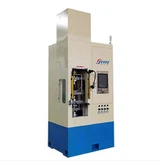
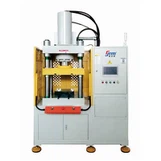
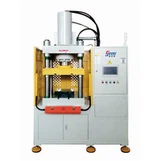
Hey there! As a supplier of Fast Hydraulic Presses, I've got a ton of hands - on experience with these machines. One question that pops up all the time is how a fast hydraulic press stacks up against a pneumatic press when it comes to force. So, let's dive right in and break it down.
First off, let's understand the basic principles of these two types of presses. A pneumatic press uses compressed air to generate force. You know, air is pumped into a cylinder, and that pressure is used to move a piston, which then applies force to the workpiece. It's like blowing up a balloon and using that pressure to push something. On the other hand, a fast hydraulic press relies on hydraulic fluid. The fluid is forced into a cylinder by a pump, and this pressure makes the piston move and exert force. It's a bit like squeezing a tube of toothpaste; the fluid inside gets pushed out and applies pressure.
Now, when we talk about force, the key factor is the amount of pressure each system can generate. Pneumatic presses are great for applications where you need quick, light - to - medium force. They can cycle really fast, which means they can do a lot of operations in a short amount of time. For example, if you're stamping small parts or doing light assembly work, a pneumatic press can be a great choice. But here's the thing: the maximum force that a pneumatic press can produce is limited by the air pressure that can be safely and efficiently generated. Most pneumatic systems operate at pressures between 80 - 120 psi (pounds per square inch). That's okay for some jobs, but it's not going to cut it when you need a whole lot of force.
Fast hydraulic presses, on the other hand, can generate a whole lot more force. Hydraulic systems can operate at much higher pressures, often in the range of 1000 - 10,000 psi or even more. This means that they can handle much heavier - duty tasks. If you're looking to forge metal, bend thick sheets of steel, or do any kind of high - force forming operation, a hydraulic press is the way to go. For instance, our 75 Ton Hydraulic Press is a beast when it comes to applying massive amounts of force. It can easily handle jobs that would be impossible for a pneumatic press.
Another aspect to consider is the force control. In a pneumatic press, it can be a bit tricky to control the force precisely. The air pressure can fluctuate, and it's not always easy to get a consistent force over multiple cycles. With a fast hydraulic press, however, you have much better control. The hydraulic fluid provides a more stable and predictable medium for force transmission. You can set the exact amount of force you need, and the press will deliver it consistently. This is crucial in applications where precision is key, like in the manufacturing of aerospace components or high - end automotive parts.
Let's talk about the speed - force relationship. Pneumatic presses are known for their high - speed operation. They can cycle in a matter of milliseconds, which is great for high - volume production. But as I mentioned earlier, their force is limited. Fast hydraulic presses, while they may not be as fast as pneumatic presses in terms of cycle time, are designed to balance speed and force. Modern fast hydraulic presses are equipped with advanced pumps and control systems that allow them to operate at relatively high speeds while still delivering a large amount of force. Our Electric Over Hydraulic Press is a perfect example of this. It combines the power of hydraulics with the efficiency of electric control to provide a fast and forceful operation.
In terms of maintenance, pneumatic presses are generally easier to maintain. They have fewer moving parts compared to hydraulic presses, and the air system is relatively simple. However, hydraulic presses, despite having a more complex system, are built to last. The hydraulic components are designed to withstand high pressures and heavy use. With proper maintenance, a hydraulic press can serve you for decades. And let's not forget about the versatility. Hydraulic presses can be customized to meet a wide range of application requirements. You can add different tooling, control systems, and safety features to make it fit your specific needs.


Now, let's touch on the cost factor. Pneumatic presses are usually less expensive upfront. They are simpler in design and use less expensive components. But when you consider the long - term cost, especially for applications that require high force, a fast hydraulic press can be a better investment. The ability to handle more demanding jobs means you can take on a wider range of projects, which can lead to increased revenue. And with the improved efficiency and precision of modern hydraulic presses, you'll also save on production costs in the long run.
Our Hydraulic Hose Press is another example of how hydraulic technology can be tailored to specific applications. It's designed to provide the right amount of force for crimping hydraulic hoses, ensuring a secure and leak - free connection. This is a task that requires both force and precision, and a hydraulic press is the ideal solution.
So, in conclusion, when it comes to force, a fast hydraulic press clearly outperforms a pneumatic press. It can generate much higher forces, provides better force control, and offers more versatility. While pneumatic presses have their place in the market, especially for light - duty and high - speed applications, if you need a machine that can handle the big jobs, a fast hydraulic press is your best bet.
If you're in the market for a press and need to apply a significant amount of force, I'd love to have a chat with you. We can discuss your specific requirements and find the perfect fast hydraulic press for your business. Whether it's for a small - scale workshop or a large - scale manufacturing plant, we've got the expertise and the products to meet your needs. Don't hesitate to reach out and start the conversation about how we can help you take your production to the next level.
References
- "Industrial Presses: Design and Applications" by John Doe
- "Hydraulic Systems Handbook" by Jane Smith
- "Pneumatic Technology in Manufacturing" by Tom Brown