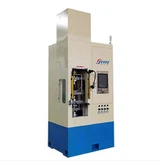
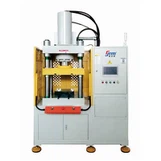
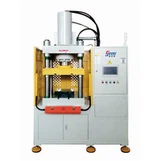
Hey there! As a supplier of Electric Over Hydraulic Presses, I often get asked about the force adjustment range of these machines. It's a crucial topic, especially for those in industries where precision and adaptability are key. So, let's dive right in and explore what the force adjustment range of an electric over hydraulic press is all about.
Understanding Electric Over Hydraulic Presses
First off, let's quickly go over what an electric over hydraulic press is. It combines the best of both worlds - the precision control of an electric system and the raw power of a hydraulic system. This type of press is used in a wide range of applications, from metal forming and stamping to plastic molding and assembly.
The electric component of the press is responsible for controlling the movement and force application. It allows for precise adjustments and repeatable operations. On the other hand, the hydraulic system provides the high force needed to perform heavy-duty tasks. Together, they create a powerful and efficient machine.


The Force Adjustment Range
The force adjustment range of an electric over hydraulic press refers to the minimum and maximum amount of force that the press can generate. This range can vary significantly depending on the model and design of the press.
Minimum Force
The minimum force is the lowest amount of force that the press can apply. This is important for delicate operations where too much force could damage the workpiece. For example, in electronics manufacturing, a small amount of force might be needed to assemble tiny components without crushing them.
The minimum force is typically determined by the design of the hydraulic system and the control settings of the electric component. Some presses can be adjusted to apply forces as low as a few pounds, while others may have a minimum force of several hundred pounds.
Maximum Force
The maximum force is the highest amount of force that the press can generate. This is crucial for heavy-duty applications such as forging and large-scale metal forming. The maximum force is usually limited by the size and capacity of the hydraulic cylinders and the power of the electric motor.
Presses can have maximum forces ranging from a few tons to several hundred tons. For instance, a small bench-top press might have a maximum force of 5 tons, while a large industrial press could generate forces of 500 tons or more.
Factors Affecting the Force Adjustment Range
Several factors can affect the force adjustment range of an electric over hydraulic press. Let's take a look at some of the most important ones.
Hydraulic System Design
The design of the hydraulic system plays a significant role in determining the force adjustment range. The size and number of hydraulic cylinders, the pressure rating of the system, and the type of hydraulic fluid used all affect the maximum and minimum forces that the press can generate.
For example, a press with larger hydraulic cylinders will generally be able to generate more force than one with smaller cylinders. Similarly, a system with a higher pressure rating will allow for greater force output.
Electric Control System
The electric control system is responsible for regulating the force applied by the press. It allows operators to set the desired force level and ensures that the press maintains that level throughout the operation.
Advanced electric control systems can provide precise force adjustment and feedback, allowing for greater accuracy and repeatability. Some systems also offer features such as programmable force profiles, which can be useful for complex operations.
Workpiece Material and Size
The material and size of the workpiece also affect the force adjustment range. Different materials have different strengths and require different amounts of force to be formed or processed. For example, harder materials such as steel will require more force than softer materials like aluminum.
Similarly, larger workpieces generally require more force than smaller ones. The press must be able to generate enough force to overcome the resistance of the material and shape it into the desired form.
Applications and the Force Adjustment Range
The force adjustment range of an electric over hydraulic press is crucial for its applications. Different industries and processes require different force levels, and the ability to adjust the force allows the press to be used in a wide variety of applications.
Metal Forming
In metal forming, the force adjustment range is essential for shaping different types of metals. For example, in sheet metal stamping, a press may need to apply a relatively low force to cut and form thin sheets of metal. On the other hand, in forging, a much higher force is required to shape thick pieces of metal into complex shapes.
Our Hydraulic Line Press is a great example of a press that can be adjusted to suit different metal forming applications. It offers a wide force adjustment range, allowing operators to work with various types of metals and thicknesses.
Plastic Molding
In plastic molding, the force adjustment range is important for ensuring that the plastic material is properly injected into the mold and formed into the desired shape. Too much force can cause the plastic to overflow or damage the mold, while too little force can result in incomplete filling of the mold.
Our presses can be adjusted to provide the right amount of force for different plastic molding processes, such as injection molding and compression molding.
Assembly Operations
Assembly operations often require precise force control to ensure that components are properly joined together without damage. For example, in automotive assembly, a press may be used to install bearings or other components with a specific amount of force.
The force adjustment range of our presses allows for accurate assembly operations, ensuring that the final product meets the required quality standards.
Why Choose Our Electric Over Hydraulic Presses
As a supplier of Electric Over Hydraulic Presses, we offer a wide range of models with different force adjustment ranges to meet the needs of various industries. Our presses are designed with the latest technology and high-quality components to ensure reliable performance and long service life.
We also provide excellent customer support, including installation, training, and maintenance services. Our team of experts is always available to help you choose the right press for your application and to answer any questions you may have.
If you're in the market for an electric over hydraulic press, whether it's a Hydraulic Baling Press Machine for waste management or a 55 Ton Hydraulic Press for heavy-duty metal forming, we've got you covered.
Contact Us for Purchase and Negotiation
If you're interested in learning more about our Electric Over Hydraulic Presses or have any specific requirements, we'd love to hear from you. Contact us today to start the conversation about purchasing and negotiation. We're committed to providing you with the best solutions for your business needs.
References
- "Hydraulic Press Technology Handbook"
- "Electric and Hydraulic Systems in Industrial Machinery"
- Industry research reports on metal forming and plastic molding processes.