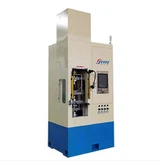
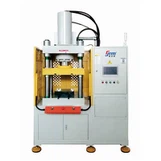
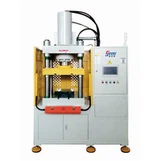
When it comes to industrial machinery, the 20 Ton Hydraulic Press is a workhorse in many manufacturing and metalworking operations. As a supplier of [Your Company's 20 Ton Hydraulic Press], I often get asked about the hydraulic cylinder diameter of a 20 Ton Hydraulic Press. This seemingly simple question is actually quite complex and involves a deep understanding of hydraulic principles, engineering design, and the specific requirements of the application.
Understanding the Basics of a Hydraulic Press
Before delving into the cylinder diameter, it's important to understand how a hydraulic press works. A hydraulic press operates on Pascal's Law, which states that when pressure is applied to a confined fluid, the pressure change occurs throughout the entire fluid. In a hydraulic press, a small amount of force applied to a small piston can generate a much larger force on a larger piston. This is achieved by transmitting the pressure through a hydraulic fluid, typically oil, which is incompressible.
The main components of a hydraulic press include a hydraulic pump, a hydraulic cylinder, a piston, and a frame. The hydraulic pump generates the pressure, which is then transferred to the hydraulic cylinder. The piston inside the cylinder moves under the pressure, exerting a force on the workpiece. The frame provides the structure and support for the entire system.
Calculating the Hydraulic Cylinder Diameter
The hydraulic cylinder diameter of a 20 Ton Hydraulic Press is determined by several factors, including the required force, the operating pressure, and the efficiency of the system. The force exerted by a hydraulic cylinder can be calculated using the formula:
[ F = P \times A ]
Where:
- ( F ) is the force in Newtons (N)
- ( P ) is the pressure in Pascals (Pa)
- ( A ) is the cross - sectional area of the piston in square meters ((m^2))
First, we need to convert the tonnage to Newtons. One ton is equivalent to 9806.65 N, so a 20 - ton hydraulic press has a force requirement of ( F = 20\times9806.65=196133\ N ).
The operating pressure of a hydraulic system can vary depending on the design and application. Common operating pressures for hydraulic presses range from 1000 to 3000 psi (6.89 to 20.68 MPa). For the sake of calculation, let's assume an operating pressure of 2000 psi or approximately 13.79 MPa ((13.79\times10^6\ Pa)).
We can rearrange the formula to solve for the cross - sectional area ( A ):
[ A=\frac{F}{P} ]
Substituting the values, we get ( A=\frac{196133}{13.79\times10^6}=0.0142\ m^2 )
The cross - sectional area of a circle (the piston) is given by the formula ( A = \pi\times(\frac{d}{2})^2 ), where ( d ) is the diameter. Rearranging this formula to solve for ( d ), we get:
[ d = 2\times\sqrt{\frac{A}{\pi}} ]
Substituting ( A = 0.0142\ m^2 ), we get ( d = 2\times\sqrt{\frac{0.0142}{\pi}}\approx0.135\ m ) or 135 mm.
However, this is a simplified calculation. In real - world applications, other factors such as the efficiency of the hydraulic system, the safety factor, and the type of hydraulic fluid used also need to be considered.
Importance of the Hydraulic Cylinder Diameter
The hydraulic cylinder diameter plays a crucial role in the performance of a 20 Ton Hydraulic Press. A larger diameter cylinder can generate more force at the same pressure, but it also requires a larger volume of hydraulic fluid to move the piston. This can result in longer cycle times and higher energy consumption. On the other hand, a smaller diameter cylinder may not be able to generate the required force, or it may need to operate at a higher pressure, which can increase the wear and tear on the system.
The diameter also affects the stability and precision of the press. A properly sized cylinder ensures that the force is evenly distributed, reducing the risk of uneven loading and damage to the workpiece. It also contributes to the overall durability of the press, as a well - designed cylinder can withstand the high pressures and forces involved in the operation.
Our 20 Ton Hydraulic Press Offerings
As a supplier of [Your Company's 20 Ton Hydraulic Press], we offer a range of hydraulic presses with different cylinder diameters to meet the diverse needs of our customers. Our 20 Ton Hydraulic Press is designed with high - quality materials and advanced manufacturing techniques to ensure reliable performance and long service life.
We also offer Fast Hydraulic Press options that are optimized for high - speed operations. These presses are equipped with specially designed cylinders that can provide rapid movement and high force output, making them ideal for applications where productivity is a key factor.
In addition, our 20 Ton Electric Hydraulic Press combines the power of hydraulics with the convenience of electric operation. It features a precise control system and a well - sized hydraulic cylinder to deliver accurate and efficient performance.
Factors Affecting the Choice of Cylinder Diameter
When choosing the hydraulic cylinder diameter for a 20 Ton Hydraulic Press, several factors need to be considered:


- Application Requirements: Different applications have different force and speed requirements. For example, a press used for stamping may require a higher force and a slower speed, while a press used for assembly may need a lower force and a faster cycle time.
- Space Constraints: The available space in the workshop or manufacturing facility can limit the size of the hydraulic cylinder. A larger diameter cylinder may not fit in a compact space, so a smaller diameter cylinder may need to be selected.
- Budget: The cost of the hydraulic cylinder increases with the diameter. A larger cylinder requires more material and more complex manufacturing processes, which can result in a higher price.
Conclusion
The hydraulic cylinder diameter of a 20 Ton Hydraulic Press is a critical parameter that affects the performance, efficiency, and cost of the press. By understanding the principles of hydraulic operation and considering the specific requirements of the application, customers can make an informed decision when choosing a hydraulic press.
At [Your Company], we are committed to providing our customers with high - quality hydraulic presses that meet their needs. Whether you are looking for a standard 20 Ton Hydraulic Press or a customized solution, our team of experts can help you select the right cylinder diameter and configuration for your application.
If you are interested in our products or have any questions about the hydraulic cylinder diameter or other aspects of our 20 Ton Hydraulic Press, please feel free to contact us for a detailed discussion and procurement negotiation. We look forward to working with you to achieve your manufacturing goals.
References
- "Hydraulics and Pneumatics: A Technician's and Engineer's Guide" by David Hewitt
- "Fluid Power Technology" by Robert L. Mott