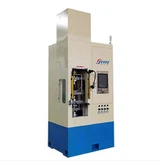
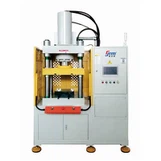
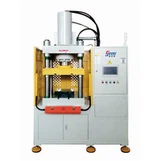
As a supplier of 20 Ton Hydraulic Presses, I've been asked numerous questions about the performance and characteristics of our products. One question that often comes up is about the pressure distribution uniformity of a 20 Ton Hydraulic Press. In this blog post, I'll delve into this topic, explaining what pressure distribution uniformity means, why it's important, and how our 20 Ton Hydraulic Presses perform in this regard.
Understanding Pressure Distribution Uniformity
Pressure distribution uniformity refers to how evenly the pressure is spread across the working surface of a hydraulic press. In an ideal scenario, when a hydraulic press applies force, the pressure should be the same at every point on the working area. This is crucial because uneven pressure can lead to a variety of problems, such as inconsistent product quality, premature wear and tear on the press components, and even damage to the workpiece.


Imagine you're using a hydraulic press to form a metal sheet into a specific shape. If the pressure is not evenly distributed, some parts of the sheet may be over - pressed while others may not be pressed enough. This can result in a deformed or uneven final product. Similarly, in a molding process, uneven pressure can cause incomplete filling of the mold cavities, leading to defective parts.
Why Pressure Distribution Uniformity Matters
The importance of pressure distribution uniformity can be seen in multiple aspects of industrial manufacturing.
Product Quality
As mentioned earlier, consistent pressure across the working surface ensures that every part of the workpiece is subjected to the same force. This leads to a more uniform product with fewer defects. For example, in the production of automotive components, where precision is of utmost importance, a hydraulic press with good pressure distribution uniformity can produce parts that meet strict quality standards.
Tool and Die Life
Uneven pressure can cause excessive stress on certain areas of the tools and dies used in the hydraulic press. This can lead to premature wear and damage, increasing the frequency of tool replacements and maintenance costs. On the other hand, a press with uniform pressure distribution reduces the stress concentration, extending the lifespan of the tools and dies.
Process Efficiency
When the pressure is evenly distributed, the press can operate more efficiently. There is less need for rework or adjustments due to defective products. This saves time and resources, ultimately improving the overall productivity of the manufacturing process.
How Our 20 Ton Hydraulic Presses Ensure Pressure Distribution Uniformity
Our company has invested a great deal of time and effort in research and development to ensure that our 20 Ton Hydraulic Presses offer excellent pressure distribution uniformity.
Advanced Design
The design of our hydraulic presses is based on the latest engineering principles. We use a combination of precision - machined components and advanced hydraulic systems to ensure that the force is transmitted evenly from the hydraulic cylinder to the working surface. The frame of the press is also designed to provide maximum stability, which helps in maintaining uniform pressure distribution.
High - Quality Hydraulic Components
We source high - quality hydraulic pumps, valves, and cylinders for our presses. These components are carefully selected for their reliability and performance. The hydraulic system is designed to provide a smooth and consistent flow of hydraulic fluid, which is essential for uniform pressure application.
Rigorous Testing
Before leaving the factory, each 20 Ton Hydraulic Press undergoes a series of rigorous tests. We use advanced pressure sensors to measure the pressure distribution across the working surface. Any deviations from the desired uniformity are carefully analyzed and corrected. This ensures that every press we deliver meets our high - quality standards.
Comparison with Other Presses
When compared to other types of presses, our 20 Ton Hydraulic Presses have several advantages in terms of pressure distribution uniformity.
Mechanical Presses
Mechanical presses rely on mechanical linkages to transmit force. These linkages can introduce some variability in the pressure distribution, especially at high speeds. In contrast, our hydraulic presses use a fluid - based system, which provides a more consistent and uniform force application.
Other Hydraulic Presses
While there are other hydraulic presses on the market, not all of them offer the same level of pressure distribution uniformity. Our presses are designed with a focus on precision and quality, which sets them apart from many of our competitors.
If you're looking for a more powerful option, you might be interested in our 100 Ton Hydraulic Press. For applications that require a specific frame design, our C Frame Press could be a great choice. And if you prefer an electric - powered option, our Electric Hydraulic Press offers excellent performance.
Conclusion
Pressure distribution uniformity is a critical factor in the performance of a hydraulic press. Our 20 Ton Hydraulic Presses are designed and manufactured to provide excellent pressure distribution, ensuring high - quality products, long tool life, and efficient manufacturing processes.
If you're in the market for a reliable 20 Ton Hydraulic Press or any other type of hydraulic press, we invite you to contact us for more information and to discuss your specific requirements. Our team of experts is ready to assist you in finding the perfect press for your application. We look forward to the opportunity to work with you and help you achieve your manufacturing goals.
References
- Smith, J. (2018). Hydraulic Press Technology. Industrial Press Publishing.
- Johnson, A. (2019). Pressure Distribution in Manufacturing Processes. Journal of Manufacturing Science.