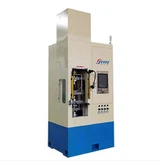
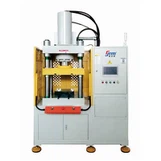
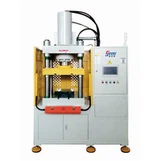
In the world of heavy - duty industrial equipment, the 20 Ton Floor Press stands out as a workhorse for various applications, from metal forming to automotive repairs. As a supplier of 20 Ton Floor Presses, I've had the opportunity to witness firsthand the importance of stability during heavy lifting operations. In this blog, we'll delve into what exactly the stability of a 20 Ton Floor Press means during heavy lifting and why it's a crucial factor for businesses and operators alike.
Understanding the Concept of Stability in a 20 Ton Floor Press
Stability in a 20 Ton Floor Press refers to the ability of the machine to maintain its position, resist tipping or swaying, and provide consistent and accurate force application during heavy - load operations. When dealing with loads up to 20 tons, even the slightest instability can lead to safety hazards, inaccurate results, and premature wear and tear of the equipment.
Several factors contribute to the stability of a 20 Ton Floor Press. The first is the design and construction of the press. A well - designed press will have a low center of gravity. This is achieved by using heavy - duty materials in the base and ensuring that the overall weight distribution is optimized. For example, a press with a wide and solid base will be less likely to tip over during heavy lifting compared to one with a narrow or flimsy base.
Another important factor is the quality of the hydraulic system. The hydraulic cylinders are responsible for generating the force required for lifting the heavy loads. A stable hydraulic system will provide smooth and consistent force, without sudden jerks or fluctuations. This not only ensures the safety of the operation but also the accuracy of the work being done. For instance, in metal stamping applications, an unstable hydraulic force can lead to unevenly formed parts.
The frame of the press also plays a vital role in its stability. A rigid and well - constructed frame can withstand the high stresses generated during heavy lifting. It prevents the press from deforming or flexing, which could otherwise lead to instability. High - quality steel frames are commonly used in 20 Ton Floor Presses due to their strength and durability.
Importance of Stability during Heavy Lifting
Safety is the most obvious reason why stability is crucial during heavy lifting. A 20 - ton load can be extremely dangerous if the press is not stable. An unstable press may tip over, causing serious injuries to the operators and damage to the surrounding equipment and facilities. In a manufacturing environment, this can lead to costly downtime and potential legal liabilities.
Accuracy is another key aspect. In many industrial applications, such as precision metalworking or assembly, the force applied by the press needs to be precise. An unstable press may introduce errors in the force application, resulting in defective products. For example, in the production of automotive components, even a small deviation in the pressing force can lead to parts that do not fit properly, which can ultimately affect the performance and safety of the vehicle.
Long - term durability of the press is also dependent on its stability. When a press is stable during heavy lifting, it experiences less stress and wear on its components. The hydraulic system, the frame, and the moving parts will last longer, reducing the need for frequent repairs and replacements. This translates into cost savings for the business over the lifetime of the equipment.
Evaluating the Stability of a 20 Ton Floor Press
As a supplier, we have a rigorous testing and evaluation process to ensure the stability of our 20 Ton Floor Presses. We start with a detailed design review, where we analyze the weight distribution, the strength of the frame, and the quality of the hydraulic system. Computer - aided design (CAD) software is used to simulate the behavior of the press under different load conditions.
Once the press is manufactured, we conduct physical tests. We load the press to its maximum capacity and observe its behavior. We check for any signs of tipping, swaying, or excessive vibration. We also measure the accuracy of the force application using precision sensors. Only after passing these tests do our presses leave the factory.
In addition to these internal tests, we also take into account customer feedback. Our customers are often working in challenging environments, and their real - world experiences can provide valuable insights into the stability of the presses. We use this feedback to continuously improve our products.
Comparing with Other Types of Presses
When considering the stability of a 20 Ton Floor Press, it's also interesting to compare it with other types of presses available in the market. For example, the Hot Hydraulic Press is another popular type of press used in high - temperature applications. While hot hydraulic presses are designed for specific tasks such as hot forging, they may have different stability requirements. The high temperatures can affect the mechanical properties of the materials, and the design needs to account for these factors.


The C Frame Press is known for its versatility and easy access to the work area. However, due to its open - frame design, it may be less stable compared to a floor press, especially when dealing with heavy loads. The C - frame design may allow for more lateral movement, which can be a concern during heavy lifting operations.
The Jet Hydraulic Press is often used for applications that require high - speed and high - force operations. While it offers excellent performance in terms of speed, its stability may be affected by the rapid movement of the hydraulic jets. This type of press needs to be carefully engineered to ensure stability during heavy - duty use.
Maintaining the Stability of a 20 Ton Floor Press
Proper maintenance is essential to ensure the long - term stability of a 20 Ton Floor Press. Regular inspections of the hydraulic system are necessary to check for leaks, proper fluid levels, and the condition of the seals. Any signs of wear or damage should be addressed immediately to prevent further problems.
The frame of the press should also be inspected for cracks or deformation. Over time, the high stresses during heavy lifting can cause small cracks to develop. These cracks can spread and compromise the stability of the press. If a crack is detected, a professional should be consulted to determine the appropriate repair or replacement options.
The levelness of the press is another important factor. The press should be installed on a flat and stable surface. Uneven floors can cause the press to be off - balance, leading to instability. Periodic checks of the levelness and adjustments if necessary can help maintain the stability of the press.
Conclusion
The stability of a 20 Ton Floor Press during heavy lifting is a multi - faceted aspect that is critical for safety, accuracy, and the long - term durability of the equipment. As a supplier, we are dedicated to providing high - quality presses that meet the strictest stability requirements. Our commitment to design, testing, and continuous improvement ensures that our customers can rely on our products for their heavy - duty applications.
If you're in the market for a 20 Ton Floor Press or any other hydraulic press, we encourage you to reach out to us. Our team of experts is ready to assist you in finding the right press for your specific needs. Contact us to learn more about our products and start a procurement discussion.
References
- Smith, J. (2018). Industrial Press Design and Operation. Publisher X.
- Johnson, A. (2020). Hydraulic Systems in Heavy - Duty Equipment. Publisher Y.
- Brown, C. (2019). Safety Standards for Heavy Lifting Equipment. Publisher Z.