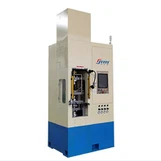
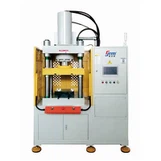
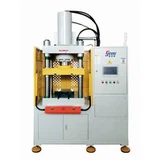
In the world of metalworking and manufacturing, C Frame presses are a staple due to their versatility and efficiency. As a leading supplier of C Frame presses, I often get asked about the types of dies that can be used with these machines. In this blog post, I'll delve into the different types of dies that are compatible with C Frame presses and how they can enhance your manufacturing processes.
Understanding C Frame Presses
Before we explore the types of dies, let's briefly understand what a C Frame press is. A C Frame press, also known as a gap-frame press, has a distinct C-shaped frame that provides an open front access to the working area. This design allows for easy loading and unloading of materials, making it suitable for a wide range of applications. These presses can be hydraulic or mechanical, and they come in various sizes and tonnages to meet different production needs.
Types of Dies for C Frame Presses
1. Blanking Dies
Blanking dies are used to cut a flat piece of material, usually sheet metal, into a specific shape. The cut piece is the desired part, and the remaining material is scrap. Blanking dies are commonly used in the production of components such as washers, gaskets, and small metal parts. They are precise and can produce high-quality parts with consistent dimensions. With a C Frame press and a blanking die, you can achieve high production rates, making it ideal for mass production. For example, if you're manufacturing small metal discs for electrical components, a blanking die can quickly and accurately cut the discs from sheet metal.
2. Piercing Dies
Piercing dies are used to create holes in a workpiece. Unlike blanking, where the cut piece is the desired part, in piercing, the material removed is scrap, and the remaining workpiece with the hole is the final product. Piercing dies can create holes of various shapes and sizes, from simple round holes to more complex shapes. They are commonly used in industries such as automotive, aerospace, and electronics. For instance, in the automotive industry, piercing dies are used to create holes in metal sheets for bolts, rivets, or wiring harnesses. A C Frame press equipped with a piercing die can efficiently pierce multiple holes in a short time, improving production efficiency.
3. Bending Dies
Bending dies are used to bend a workpiece into a specific angle or shape. They are commonly used in the production of brackets, channels, and other components that require a bent profile. Bending dies come in various designs, such as V-dies and wipe dies, depending on the type of bend required. The advantage of using a C Frame press with a bending die is that it can provide precise control over the bending process, ensuring consistent bend angles and quality. For example, if you're manufacturing metal brackets for furniture, a bending die can easily bend the metal sheets to the desired angle, saving time and labor.
4. Forming Dies
Forming dies are used to reshape a workpiece into a three-dimensional shape. This process involves deforming the material without removing any of it. Forming dies can be used to create complex shapes such as cups, shells, and automotive body parts. They require a high tonnage press to apply enough force to reshape the material. A C Frame press with a forming die can handle medium to high-tonnage applications, making it suitable for a variety of forming operations. For instance, in the production of kitchen utensils, forming dies can shape flat metal sheets into cups and bowls.
5. Drawing Dies
Drawing dies are used to convert a flat sheet of material into a hollow shape, such as a cup or a tube. The process involves pulling the material through a die to create the desired shape. Drawing dies require a precise control of force and speed to prevent tearing or wrinkling of the material. A C Frame press with a drawing die can provide the necessary force and control for successful deep drawing operations. For example, in the production of beverage cans, drawing dies are used to shape the aluminum sheets into the cylindrical shape of the can.
Compatibility and Considerations
When choosing a die for your C Frame press, it's important to consider several factors. First, the tonnage of the press must be compatible with the die. The press should be able to provide enough force to perform the die operation. Second, the size of the die should fit within the working area of the press. The die must be securely mounted on the press bed and the ram to ensure accurate and safe operation. Additionally, the type of material being processed also affects the choice of die. Different materials have different properties, such as hardness and ductility, which require specific die designs.
Our Product Offerings
As a C Frame press supplier, we offer a wide range of presses that are compatible with various types of dies. Our Hydraulic Press with Foot Pedal provides convenient operation, allowing the operator to control the pressing force with a foot pedal. This is especially useful for applications that require frequent on-off operations. Our 30 Tonne Hydraulic Press is suitable for medium to heavy-duty applications, such as deep drawing and forming. It can handle large dies and thick materials with ease. For applications that require high temperatures, our Hot Hydraulic Press is the ideal choice. It provides precise temperature control, ensuring accurate shaping of materials at elevated temperatures.
Conclusion and Call to Action
In conclusion, the versatility of C Frame presses allows them to be used with a wide variety of dies, including blanking, piercing, bending, forming, and drawing dies. Each type of die offers unique capabilities and is suitable for different manufacturing applications. By choosing the right die for your C Frame press, you can enhance your production efficiency, improve the quality of your products, and reduce costs.
If you're interested in learning more about our C Frame presses or discussing the types of dies that would be suitable for your specific needs, we invite you to contact us for a procurement discussion. Our team of experts is ready to assist you in finding the perfect solution for your manufacturing operations.


References
- "Metalworking Dies: A Complete Guide" - Industrial Press Handbook
- "Pressworking Operations and Dies" - Society of Manufacturing Engineers